
Quick answer: Replace brake pads when they reach the minimum thickness in your vehicle’s service manual, or sooner if you hear the wear indicator squeal, see a pad wear warning light or hear grinding. Replace rotors when they are below the minimum thickness marked on them, or are cracked, deeply scored, heat-damaged or causing pulsation. Always work on both sides of an axle together.
This guide explains how each part of a disc brake wears, how to read the warning signs, and when the job belongs with a professional. Each section links to a more detailed guide.
How your brakes work, and what wears out
When you press the pedal, the master cylinder sends brake fluid pressure to each wheel. On a disc brake, a caliper squeezes two brake pads against a spinning rotor (also called a disc). On a drum brake, a wheel cylinder pushes brake shoes outward against the inside of a drum. Either way, friction turns the car’s motion into heat. Brake maker Wagner points out that braking shifts the vehicle’s weight forward, so the front brakes do most of the work.
| Part | What it does | What wears or fails | Detailed guide |
|---|---|---|---|
| Brake pads | Friction material clamped against the rotor | Designed to wear; the part replaced most often | When to replace brake pads |
| Rotors (discs) | The surface the pads grip; also absorbs heat | Wear thinner; can be scored, cracked or develop uneven thickness | Rotors vs pads |
| Pad wear sensors | Turn on a dashboard light when the pads are low (on vehicles that have them) | Single-use once the pad wears down to them | Brake pad wear sensors |
| Caliper, slide pins and hardware | Hold the pads and let them move freely; shims and clips reduce noise | Slides seize, boots tear, shims and clips corrode | Squealing or grinding brakes |
| Shoes, drums and wheel cylinders | Drum brakes, used on some vehicles | Shoes and drums wear; wheel cylinders can leak | Drum brakes, below |
Warning signs and what they usually mean
Most brake problems give some warning. These are the signs that brake makers and automakers list most often:
| Sign | What it usually means | What to do |
|---|---|---|
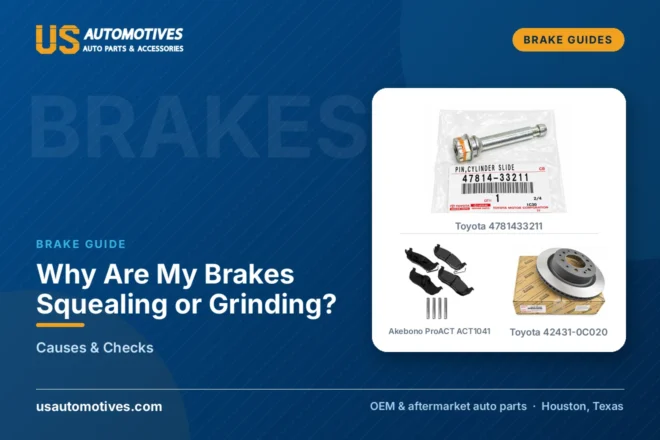
| High-pitched squeal when you brake | The pad’s built-in metal wear indicator is touching the rotor. Nissan says its indicators are designed to squeak when the pads are almost worn out. | Check the pads soon and replace them if they are at the limit. |
| Pad wear warning light on the dash | An electronic wear sensor has reached its limit (vehicles with sensors only). | Replace the pads and the sensor. |
| Grinding or growling | Wagner says this means the pads have worn through and are grinding into the rotors. | Don’t keep driving on it. Have the brakes inspected right away. |
| Pulsating pedal or shaking steering wheel when braking | Usually uneven rotor thickness or runout. Nissan says pulsation is not caused by warped discs. | Have the rotors measured. |
| Car pulls to one side under braking | The brakes are not applying evenly, for example because of a sticking caliper or slide. | Have it inspected promptly. |
| Rattling or clicking | Wagner links this to pads that need replacing; check the hardware as well. | Check the pads, clips and shims. |
| Burning smell, fading brakes | Overheating. Wagner notes that overheated pads can glaze and lose stopping ability. | Slow down, pull over safely and let the brakes cool, then have them checked. |
| Red brake warning light | It can mean low brake fluid or another brake system fault. Your owner’s manual explains it for your vehicle. | Pull over when safe and check the manual. Low fluid can mean a leak, so have it checked before driving on. |
| Yellow ABS light | The anti-lock system has found a fault and is usually switched off. Regular braking normally still works. | See our guide to ABS wheel speed sensor codes. |
A pedal that feels soft, sinks toward the floor or travels farther than usual can point to a hydraulic problem. Treat it, like a red brake warning light, as a reason to stop driving until the brakes have been checked.
Brake pads: when to replace them
There is no reliable mileage rule for pads. How long they last depends on the vehicle, the pad formulation, the roads you drive and how you brake, so check the thickness instead of counting miles.
- Look first. On many vehicles you can see the outer pad through the wheel spokes with a flashlight, as Wagner’s guide describes. The inner pad can wear differently, so a proper check means taking the wheel off.
- Compare with the specification. Your service manual lists the minimum pad thickness for your vehicle. Rules of thumb from brake makers differ, so go by the figure for your car.
- Read the wear pattern. Delphi notes that an inner pad worn much more than the outer one can mean a caliper piston isn’t returning, while a worn outer pad or a tapered pad points to seized slides or guide pins. New pads alone won’t cure either.
Our guide on when to replace brake pads covers the signs, the built-in indicators and a step-by-step check.
Ceramic, semi-metallic or organic pads?
| Pad type | Strengths | Trade-offs |
|---|---|---|
| Ceramic | Quiet, low dust and long-lasting; Wagner calls them ideal for most normal driving | ADVICS says most drivers prefer semi-metallic pads for towing, track or performance driving |
| Semi-metallic | Good stopping power and very efficient at shedding heat (Wagner) | Can be noisy, make more dust than ceramic pads and wear rotors more aggressively (Wagner) |
| Organic (NAO) | Soft and quiet (Wagner) | Wear faster and may produce dust; best for lighter vehicles that don’t need a lot of hard braking (Wagner) |
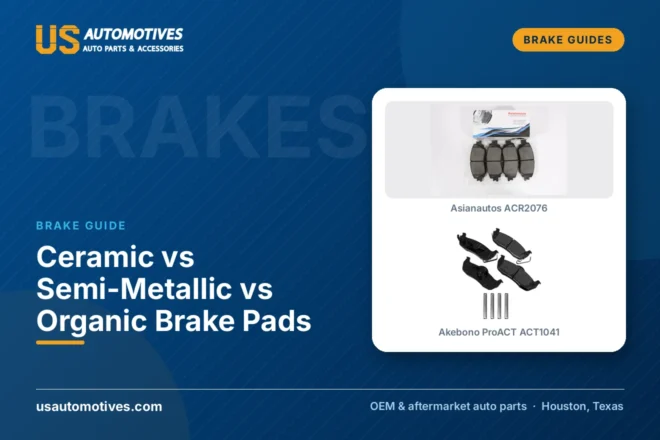
Most of the pad sets in our disc brake pad set category are ceramic formulations. See ceramic vs semi-metallic vs organic brake pads for how to choose.
Rotors: resurface or replace?
Every rotor has a minimum thickness. Brembo explains that it is marked on the rotor as “MIN TH” followed by a value in millimeters, and it is also in the service manual. Measure with a micrometer at several points (Brembo says at least four) and use the lowest reading for the whole rotor.
Replace the rotor if:
- it is at or below the minimum thickness, or resurfacing it would take it below the machining limit;
- it has cracks, deep scoring, or dark or blue spots from overheating (Brembo). Wagner says rotors with blue spots should always be replaced, together with the pads;
- it causes pulsation that can’t be machined out without going below the minimum.
Resurfacing (machining, or “turning”) only works when enough thickness remains above the limit, and it isn’t automatic with every pad change. In a service bulletin reported by MOTOR magazine, GM told technicians to resurface rotors only for specific problems such as severe scoring, pulsation or heavy corrosion, and not for routine pad replacement or to cure squeal. Brembo’s general rule of thumb is to replace rotors at every other pad change, but the measurements on your own rotors decide.
Read more in brake rotors vs brake pads: do you need to replace both? Replacement rotors are in our disc brake rotor category.
Pad wear sensors
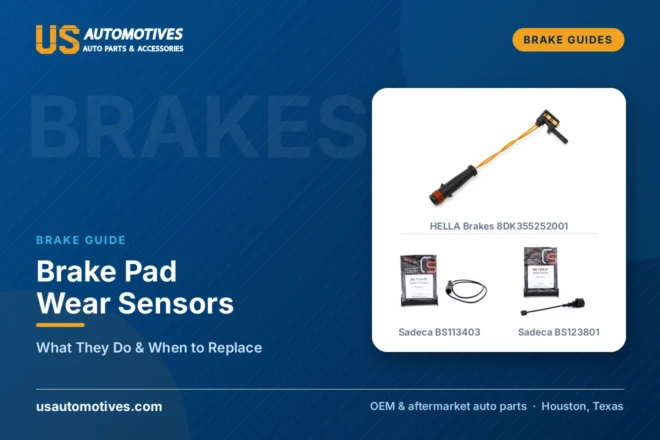
Some vehicles use an electronic sensor that clips into the pad. When the pad wears down to it, a warning light comes on. HELLA’s technical information says these electrical contacts must be replaced every time the pads are replaced, and that a vehicle may have two or four of them. Some vehicles also need a service reset afterward. HELLA’s service information for BMW F10/F11 models says the brake pad reset only works with a new sensor fitted.
In our catalog, pad wear sensors are listed mostly for European makes such as BMW, Porsche, Audi, Land Rover and Mercedes-Benz, plus some Lexus models. A pad wear sensor is a different part from an ABS wheel speed sensor. Details are in brake pad wear sensors: what they do and when to replace them.
Why brakes are replaced per axle
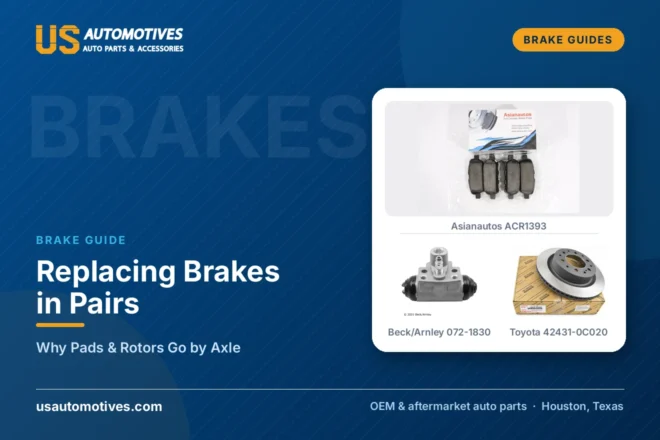
Brembo’s pad fitting instructions say the pads “must always be replaced throughout the vehicle axle,” and its rotor guidance says both rotors on an axle must be replaced even if only one is below the minimum. Matching parts side to side keeps braking even; Wagner notes that a car pulling to one side under braking means the brakes are not being applied evenly. The front and rear axles are separate jobs, each judged on its own condition. More in replacing brakes in pairs.
Drum brakes
Some vehicles use drum brakes, for example on the rear axle. The shoes wear like pads, and the drum wears like a rotor, except that its inside diameter grows as it wears. The limit is in the service manual and is often stamped on the drum itself; Dodge service information, for example, says to “refer to limit stamped on drum.” A wheel cylinder that leaks brake fluid needs attention right away. NAPA’s Know How guide says the main tell-tale sign is fluid leaking onto the tire. We carry brake drums and drum brake wheel cylinders.
Do it yourself or see a mechanic?
Brakes are safety-critical. If you do the work yourself:
- Use the service manual for your exact vehicle for the procedure, the minimum thicknesses and every torque value. Brembo’s instructions refer you to the tightening torque prescribed by the vehicle manufacturer.
- Support the vehicle on jack stands on firm, level ground. Never work under a car held up only by a jack.
- Work on one side at a time and use the other side as a reference, as Brembo recommends.
- Check the caliper and hardware. Brembo says to replace corroded guide bolts and damaged dust boots, replace worn or damaged shims, and replace a caliper that shows fluid contamination or other damage.
- Watch the brake fluid reservoir. Brembo notes that pushing the caliper pistons back raises the fluid level, and that spilled fluid can damage paint.
- Press the brake pedal before you drive to bring the pads into position, as Brembo’s instructions say. Don’t move the car until the pedal feels normal.
- Bed in the new pads as the vehicle or pad maker instructs. Brembo warns that brakes that are not properly broken in may not work as they should.
If you are unsure about any step, if a red brake warning light is on, or if the pedal feels wrong, have a qualified technician inspect the brakes before you drive.
Brake parts from US Automotives
Browse all brake parts, or start with these examples:
| Part | Brand | Listed for | Price |
|---|---|---|---|
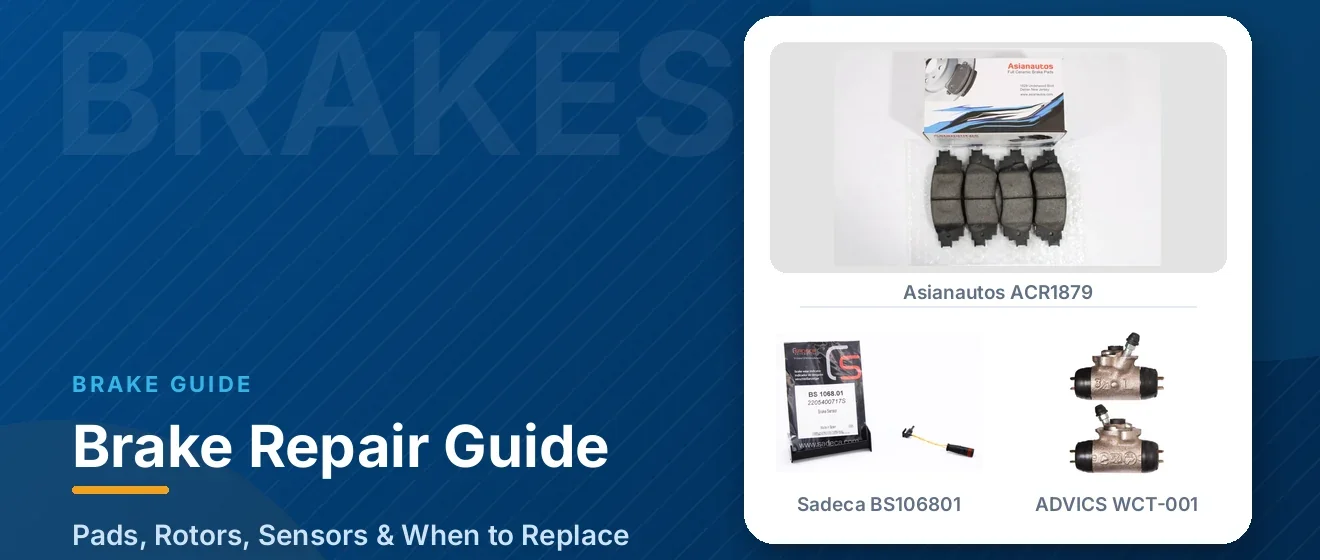
| Asianautos ACR1879 Premium Ceramic Disc Brake Pad Set | Asianautos | Lexus, Toyota | $26.42 |
| Fremax BD1257 Disc Brake Rotor | Fremax | Acura, Honda, Isuzu | $35.70 |
| Sadeca BS106801 Disc Brake Pad Wear Sensor | Sadeca | Mercedes-Benz | $10.04 |
| Fremax BD5191 Brake Drum | Fremax | Toyota | $53.42 |
| ADVICS WCT-001 Drum Brake Wheel Cylinder | ADVICS | Toyota | $16.93 |
Prices may change; the product page shows the current price. “Listed for” shows the makes on each listing. Check the full fitment list for your year, model and wheel position before ordering, or send us your VIN and our team will confirm fitment.
Standard shipping is free to the lower 48 states with no minimum order. In-stock orders placed before 2:00 PM ET usually ship the same business day, and unused parts in their original packaging can be returned within 30 days.
FAQ
How long do brake pads last?
There is no single answer. Pad life depends on the vehicle, the pad type, traffic, terrain, load and driving style. Have the pads checked whenever the wheels are off, for example at a tire rotation, and follow the inspection schedule in your owner’s manual.
Do I have to replace the rotors every time I replace the pads?
No. Measure them first. Rotors that are above the minimum thickness and free of cracks, deep grooves, heat spots and pulsation can often stay in service. Otherwise, resurface or replace them, always as a pair.
Can I replace only the front brakes?
Yes. The front and rear axles are serviced separately. What you shouldn’t do is replace the pads or a rotor on only one side of an axle.
Is it safe to drive with a brake warning light on?
A pad wear light means the pads have reached their limit and should be replaced soon. A red brake warning light or a soft pedal means you should stop and have the brakes checked first. If only the ABS light is on, see our ABS sensor guide.
Safety note: This guide is general information and may not match your vehicle. Follow your vehicle’s service manual, and have a qualified technician inspect your brakes if you are unsure about any part of the job. US Automotives is an independent retailer and is not affiliated with any vehicle manufacturer.