
Quick answer: Ceramic pads are the usual choice for everyday driving: quiet, low in dust and long-lasting. Semi-metallic pads handle heat well and suit towing and hard use, but they tend to be noisier, dustier and harder on rotors. Organic (NAO) pads are soft and quiet but wear faster. If you’re unsure, start with the type your vehicle came with.
The three pad types at a glance
| Ceramic | Semi-metallic | Organic (NAO) | |
|---|---|---|---|
| Made of | A durable ceramic compound, often blended with other materials for friction and heat control (ADVICS) | Roughly 30 to 70 percent metals such as copper, iron or steel, plus graphite lubricant and fillers (ADVICS) | Materials such as rubber, carbon and glass or fiberglass, bound with resin (ADVICS) |
| Strengths | Excellent stopping power, very little dust or noise, long-lasting (Wagner) | Good stopping power, very efficient at dispersing heat (Wagner) | Softer than most pads, which makes them quieter (Wagner) |
| Trade-offs | ADVICS says not every vehicle is compatible with ceramic pads | Can be noisy, makes more dust than ceramic and may wear rotors more aggressively (Wagner) | Wear faster and may produce dust (Wagner) |
| Usually suits | Most normal driving (Wagner) | Towing, performance or track driving (ADVICS) | Lighter vehicles that don’t need a lot of hard braking (Wagner) |
These are general traits. Every brand’s formula is different, so two “ceramic” pads from different makers can behave differently.
Ceramic brake pads
Ceramic pads are built around a ceramic compound rather than a high metal content. Wagner says they have excellent stopping power, disperse heat well, produce very little dust or noise and last a long time, which makes them ideal for most normal driving. ADVICS adds that ceramic pads leave a finer dust than semi-metallic pads, so wheels stay cleaner, and that they cause less wear on the rotors.
Wagner also notes that many foreign and domestic vehicles come from the factory with ceramic pads. ADVICS cautions that not all makes and models are compatible with ceramic pads and advises checking before you switch.
Semi-metallic brake pads
Semi-metallic pads contain a large share of metal fibers. According to ADVICS, that metal conducts heat away well and gives good braking across a wider range of temperatures and conditions, which is why most drivers prefer them for performance driving, track use or towing.
The trade-offs come from the same hard, metallic makeup. Wagner says semi-metallic pads can be noisy, create more dust than ceramic pads and may wear rotors more aggressively. ADVICS also describes them as potentially noisier than ceramic pads.
Organic (NAO) brake pads
NAO stands for non-asbestos organic. These pads use softer materials bound together with resin. Wagner says the softness makes them quieter, but they wear faster and may produce dust, so they are best for lighter vehicles that don’t need a lot of hard braking. ADVICS describes them as suited to everyday driving in non-performance vehicles.
What about copper?
Copper was once common in brake pads. Under the EPA’s Copper-Free Brake Initiative, the industry agreed to reduce copper in brake pads to less than 5 percent by weight in 2021 and to 0.5 percent by 2025, and to mark the packaging. The limits apply across pad types, so they don’t change how you choose between ceramic, semi-metallic and organic pads.
How to choose
- Start with what the vehicle came with. A dealer parts department or the service information for your vehicle can tell you which type was fitted originally.
- Think about how you drive. For commuting and everyday errands, ceramic pads fit Wagner’s “most normal driving” description. For regular towing, heavy loads, mountain driving or track days, ADVICS says most drivers prefer semi-metallic pads.
- Check compatibility before switching types. ADVICS advises research, because not every vehicle is compatible with ceramic pads. If you’re unsure, ask the pad maker or ask our team.
- Replace both sides of the axle together with the same pads. Brembo’s fitting instructions say pads must always be replaced throughout the axle.
- Check the rotors. A new pad of any type needs a smooth rotor that is above its minimum thickness.
- Bed the pads in following the instructions from the pad or vehicle maker.
Pad type is only part of the story when it comes to noise. Shims, clips and lubricated slides matter too; see why brakes squeal or grind.
Brake pads in our catalog
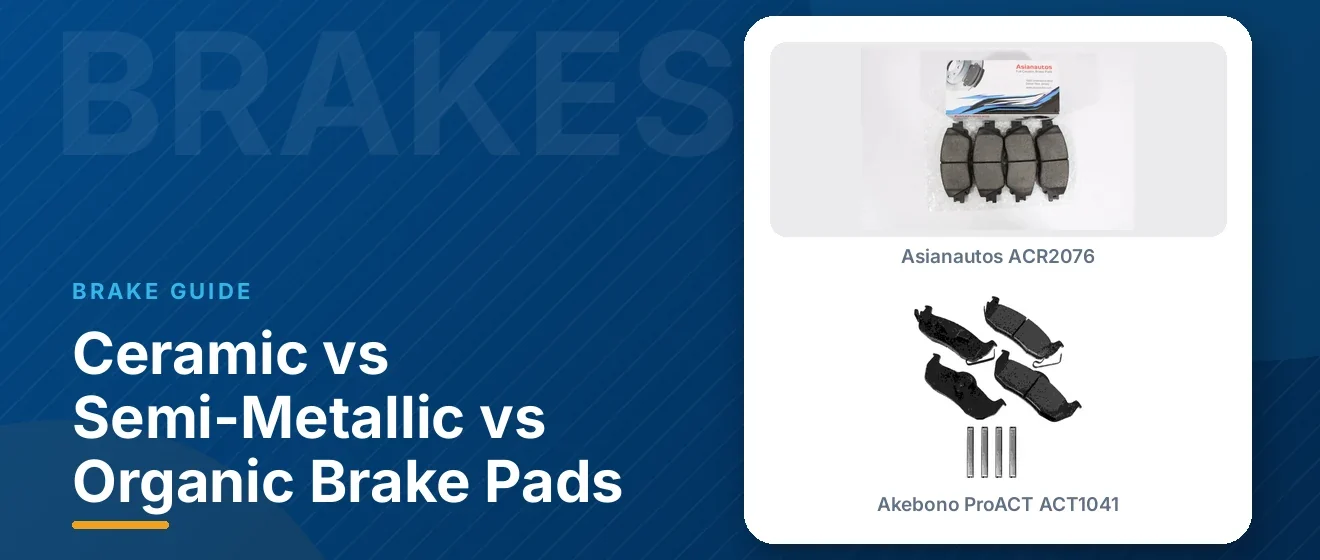
Most of the pad sets in our disc brake pad set category are ceramic formulations, including the Asianautos Premium Ceramic line and Akebono’s ProACT and EURO lines. Akebono describes its ProACT pads as using “vehicle-optimized ceramic formulas” with “low-dust braking performance,” and says its EURO pads are formulated for European vehicles. These are the maker’s own claims. Examples:
| Part | Brand | Listed for | Price |
|---|---|---|---|
| Asianautos ACR2076 Premium Ceramic Disc Brake Pad Set | Asianautos | Lexus, Toyota | $31.26 |
| Akebono ProACT ACT1338B Ceramic Disc Brake Pad Kit | Akebono | Nissan, Suzuki | $71.37 |
| Akebono EURO EUR1761 Ceramic Disc Brake Pad Kit | Akebono | Audi, Volkswagen | $70.61 |
Prices may change; the product page shows the current price. “Listed for” shows the makes on each listing. Check the full fitment list for your year, model and axle before ordering. If you need a semi-metallic pad for towing or heavy use, contact us with your VIN and we’ll tell you what we can supply.
FAQ
Which brake pads make the least dust?
Of the three types, ceramic pads. Wagner says they produce very little dust, and ADVICS says their dust is finer than that of semi-metallic pads.
Are semi-metallic pads better for trucks and towing?
ADVICS says most drivers prefer semi-metallic pads for towing because they brake well across a wider range of temperatures. Check what your vehicle maker specifies, especially if you tow near the vehicle’s rated limit.
Can I switch from semi-metallic to ceramic pads?
It depends on the vehicle. ADVICS notes that not every vehicle is compatible with ceramic pads, so confirm with the pad maker’s application list or ask us before you order.
For more on pad wear and replacement timing, see when to replace brake pads and our brake repair guide.
Safety note: Brakes are safety-critical. This guide is general and may not match your vehicle. Follow your vehicle’s service manual and the pad maker’s instructions, and have a qualified technician inspect the brakes if you are unsure. US Automotives is an independent retailer and is not affiliated with any vehicle manufacturer.