
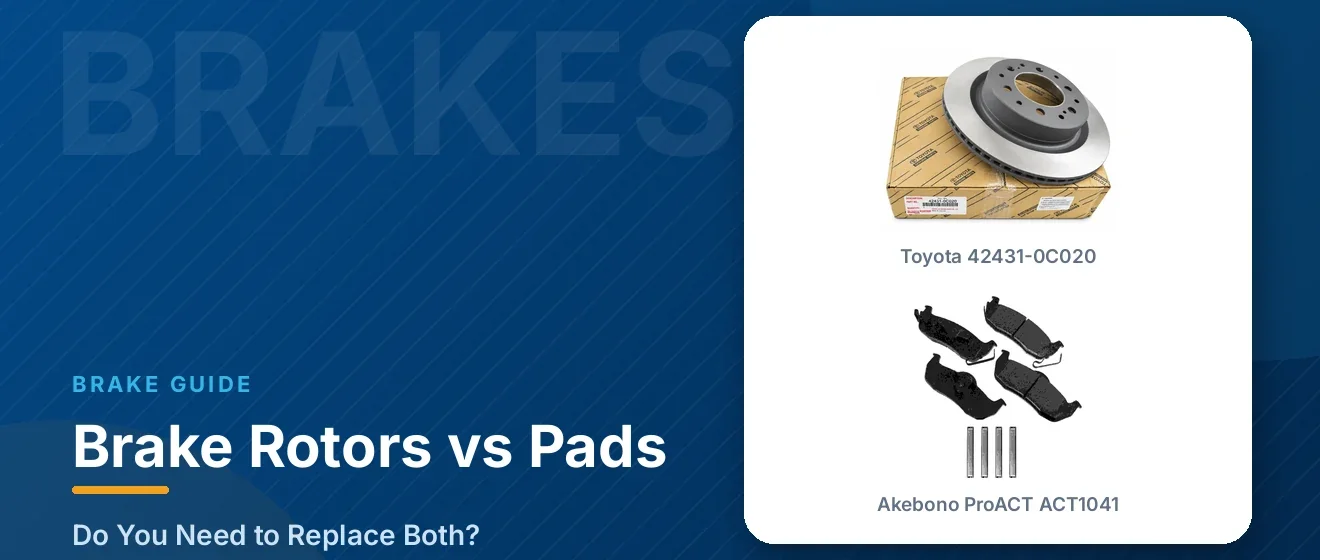
Quick answer: Not always. Pads are replaced at every brake job, but rotors only need replacing when they are at or below the minimum thickness marked on the rotor or listed in the service manual, can’t be resurfaced without going under it, or are cracked, deeply scored, heat-damaged or causing pulsation. Measure the rotors before you decide, and treat both rotors on an axle as a pair.
Pads vs rotors: what each part does
| Brake pads | Brake rotors | |
|---|---|---|
| Job | Friction material that the caliper presses against the rotor | The metal disc the pads clamp; it also absorbs and sheds heat |
| How they wear | Designed to wear away with use | Wear more slowly, getting thinner with each stop |
| Replacement limit | Minimum pad thickness in the service manual | Minimum (“discard”) thickness marked on the rotor and in the service manual |
| Typical warning signs | Squeal from the wear indicator, pad wear light, grinding | Pulsating pedal, vibration, deep grooves, cracks, blue heat spots |
For the pad side of the decision, see when to replace brake pads.
Minimum thickness: the number that decides
Every rotor has a minimum thickness. Brembo explains that it is etched on the rotor as “MIN TH” followed by a value in millimeters. Your vehicle’s service manual lists it too, and it is the place to look if rust has made the marking unreadable. We don’t publish these figures because they differ from one rotor to the next.
A MOTOR magazine article on rotor service separates three numbers:
- Nominal thickness: the thickness when new.
- Machine-to thickness: the thinnest a rotor can be machined to and still go back into service.
- Discard thickness: the point at which the rotor must be replaced. MOTOR says a rotor below it should never be reinstalled.
Measure with a micrometer at several points around the rotor. Brembo says to measure at least four points and use the lowest reading for the whole rotor; MOTOR recommends eight. A pointed-anvil rotor micrometer reaches into grooves, so it finds the real minimum on a scored rotor.
When a rotor must be replaced
- It is at or below the minimum thickness.
- It is above the minimum now but would end up below the machining limit after resurfacing.
- It has cracks or deep circular scoring (Brembo).
- It has dark or blue spots from overheating. Brembo lists these as a reason to replace, and Wagner says rotors with blue spots should always be replaced together with the pads.
- It is deformed or causes pulsation that can’t be machined out within the limit.
Wagner also warns against fitting new pads to a damaged rotor: the pad won’t contact the surface properly, and deep grooves in a worn rotor act like a shredder on new pad material.
Resurfacing: when it makes sense
Resurfacing (machining, or “turning”) cuts a thin layer off both faces to restore a flat, parallel surface. Wagner says a mechanic can turn a rotor while still leaving the minimum thickness, which is possible when a problem is caught early.
It isn’t automatic with every pad change. MOTOR points out that lighter modern cars use thinner rotors with less material to remove, so the first resurfacing may be the only one before replacement. MOTOR also quotes a GM service bulletin that says rotors should only be turned for specific conditions:
- severe scoring;
- pulsation from excessive lateral runout;
- thickness variation beyond the specification;
- excessive corrosion on the braking surfaces.
The same bulletin says not to resurface rotors for noise or squeal, cosmetic corrosion, discoloration, or routine pad replacement. That is GM’s guidance for its vehicles, but it is a useful test for any car: resurface or replace only for a measured problem.
Pulsation usually isn’t a “warped” rotor
A pulsating pedal or a shaking steering wheel under braking is often blamed on warped rotors. Nissan says pulsation is not caused by warping and is instead caused by thickness variation in the rotor, which excess heat or improper wheel torquing can produce over time. MOTOR adds lateral runout, a side-to-side wobble that can come from a worn wheel bearing, rust or dirt between the hub and rotor, or wheel fasteners that were tightened unevenly.
The fix is to resurface or replace the rotors and correct the cause: clean the hub face, check runout, and tighten the wheels to the torque in the service manual.
Quick decision guide
| What you find | Pads | Rotors |
|---|---|---|
| Pads at the limit; rotors smooth, above the minimum, no pulsation | Replace | Often reusable; measure to confirm |
| Pulsation, rotors well above the minimum | Replace if worn | Resurface or replace, and correct the cause |
| Rotors at or near the minimum | Replace | Replace |
| Grinding, deep grooves, cracks or blue spots | Replace | Replace |
Brembo’s general rule of thumb is that rotors are replaced at every other pad change. Treat that as a rough guide only; the measurements on your own rotors decide.
Always work in pairs
Brembo says both rotors on an axle must be replaced even if only one is below the minimum. The same goes for pads on both wheels of the axle. Our guide on replacing brakes in pairs explains why.
Parts you’ll need
See our disc brake rotors and disc brake pad sets. Examples:
| Part | Brand | Listed for | Price |
|---|---|---|---|
| Fremax BD0586 Disc Brake Rotor | Fremax | Hyundai, Kia | $88.12 |
| Fremax BD4702 Disc Brake Rotor | Fremax | Saab, Scion, Subaru, Toyota | $38.77 |
| Fremax BD1275 Disc Brake Rotor | Fremax | Acura, Honda | $46.16 |
Prices may change; the product page shows the current price. “Listed for” shows the makes on each listing. Front and rear rotors are different parts, so check the full fitment list for your year, model and axle, and check whether a listing is for one rotor or a pair. If anything is unclear, send us your VIN and our team will confirm fitment before you order.
FAQ
Can I put new pads on old rotors?
Yes, if the rotors measure above the minimum and are smooth, flat and free of cracks and heat spots. Wagner warns that grooved rotors damage new pad material and keep the pad from contacting the rotor properly.
Should I resurface or replace?
Resurfacing is only an option if the rotor will still be above its machine-to limit after the cut. MOTOR notes that thin, unvented rear rotors are often replaced rather than resurfaced because they have so little material to spare.
Do new rotors need bedding in?
Follow the bedding-in instructions from the vehicle, pad or rotor maker. Brembo says new pads and rotors should be road tested and bedded in with brief, gradual braking.
For the full picture, read our brake repair guide.
Safety note: Brakes are safety-critical. This guide is general and may not match your vehicle. Use the minimum thickness and torque values in your vehicle’s service manual, and have a qualified technician inspect the brakes if you are unsure. US Automotives is an independent retailer and is not affiliated with any vehicle manufacturer.