
Quick answer: Replace brake pads when the friction material is down to the minimum thickness in your vehicle’s service manual, or as soon as you hear the built-in wear indicator squeal, see a pad wear warning light, or hear grinding. Pad life varies too much with the vehicle, pad type and driving for a mileage rule to be reliable, so check the pads themselves.
Signs your brake pads are worn
| Sign | What’s going on | How urgent |
|---|---|---|
| High-pitched squeal when braking | A metal wear indicator on the pad is touching the rotor. Mazda and Nissan both describe this squeal as a deliberate warning that the pads are nearly worn out. | Replace the pads soon. Nissan says to replace them as soon as possible. |
| Pad wear light on the dashboard | On vehicles with electronic sensors, the pad has worn down to the sensor. | Replace the pads and the sensor soon. |
| Grinding or growling | Wagner says the pads have worn through and are grinding into the rotors. | Stop driving on it and have the brakes inspected right away. The rotors will likely need attention too. |
| Rattling or clicking | Wagner lists this as a sign the pads need replacing; the hardware should be checked too. | Inspect soon. |
| Pulling to one side | The brakes are not applying evenly. A pad that drags or doesn’t contact the rotor is one possible cause. | Have it inspected promptly. |
| Longer stopping distances | Nissan lists longer stopping times among the signs that brakes need service. | Have it inspected promptly. |
A soft or sinking pedal, or a red brake warning light, is a different kind of problem and can point to the hydraulic system. Don’t keep driving; have the brakes checked first.
How built-in wear indicators work
Many pads warn you before they’re fully worn. There are three common kinds of indicator:
- Mechanical (acoustic) indicator. HELLA describes a small metal plate on the pad’s backing plate. When the pad reaches its wear limit, the plate touches the rotor during braking and squeals. There is no electronics involved.
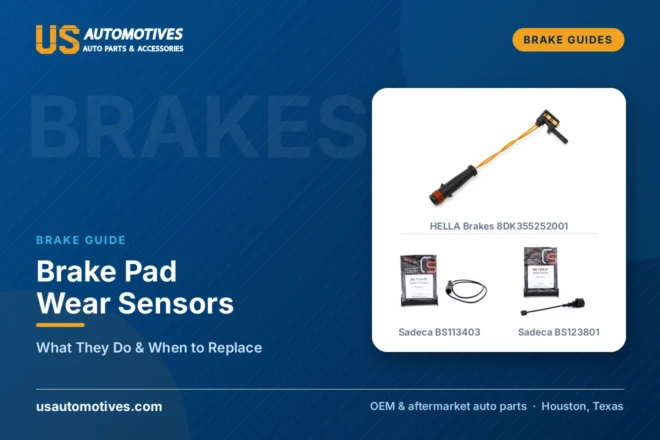
- Electronic sensor. A sensor clipped into the pad completes or breaks a circuit when the pad wears down to it, and a warning light comes on. HELLA says electrical sensors must be replaced every time the pads are replaced. Our guide to brake pad wear sensors explains the details.
- Wear slot. Some pads have a groove cut into the friction material. Wagner’s guide says that if the slot is gone or barely visible, it’s time for new pads.
Treat these as a last warning, not a service schedule. Nissan says its indicators are set to squeal when about 2 mm of friction material remains, and HELLA says the limit for electronic contacts is usually about two millimeters. These figures vary between vehicles and pad makers, so the minimum for your car is the one in its service manual.
How to check your brake pads
- Park safely. Choose level ground, set the parking brake and let the brakes cool. Brakes can be hot enough to burn after driving.
- Look through the wheel. On many vehicles you can see the outer pad through the spokes. A flashlight helps.
- Take the wheel off for a proper look. Raise the vehicle with a jack at the correct lifting point and support it on jack stands before removing the wheel. Never rely on the jack alone.
- Check both pads at each wheel. The inner pad can wear differently from the outer one and is often hard to see without removing the wheel.
- Compare with the specification. Measure the friction material, not the steel backing plate, and compare it with the minimum in the service manual. As a rule of thumb, Wagner’s consumer guide suggests seeing your mechanic once a pad is thinner than about 1/4 inch.
- Look at the rotor while you’re there. Wagner notes that with the wheel off you can see the caliper, rotor and brake lines too. Deep grooves, cracks or blue heat spots mean the rotor needs attention.
- Check the brake fluid level. Tesla’s service information, for example, says the level drops slightly as the pads wear but should not drop below the MIN mark. A level below MIN, or a sudden drop, needs inspection.
What uneven pad wear tells you
Comparing the pads at one wheel can reveal a problem that new pads alone won’t fix. Brake maker Delphi gives these patterns:
| Wear pattern | Likely cause (Delphi) |
|---|---|
| Even wear on inner and outer pads | The system is working normally. Replace the pads and hardware and service the guide pins and slides. |
| Outer pad worn more than inner | The mounting hardware is making the caliper seize: seized sliders, guide pins or dry bolts. |
| Inner pad worn more than outer | The caliper piston is hanging up and not returning to its rest position. |
| Tapered pad (thicker at one end) | Worn guide pins or a seized slider, or a pad that was installed incorrectly. |
Delphi’s remedies include lubricating the sliders, servicing or replacing caliper hardware and, for a sticking piston, inspecting the caliper and checking for residual hydraulic pressure.
Do you need new rotors too?
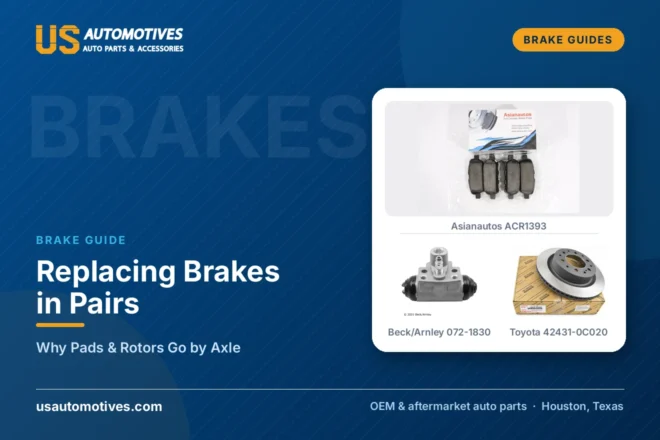
Not always. A rotor that is above its minimum thickness and free of cracks, deep scoring and pulsation can often be reused. Our guide on brake rotors vs brake pads explains how to decide. Either way, pads are replaced on both wheels of an axle at the same time. Brembo’s fitting instructions say pads must always be replaced throughout the axle.
Parts you’ll need
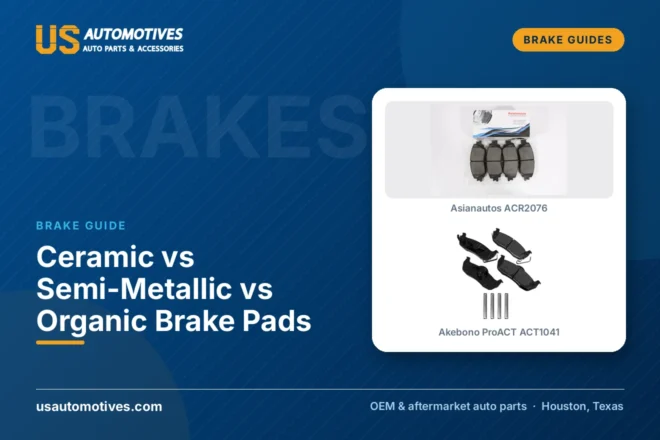
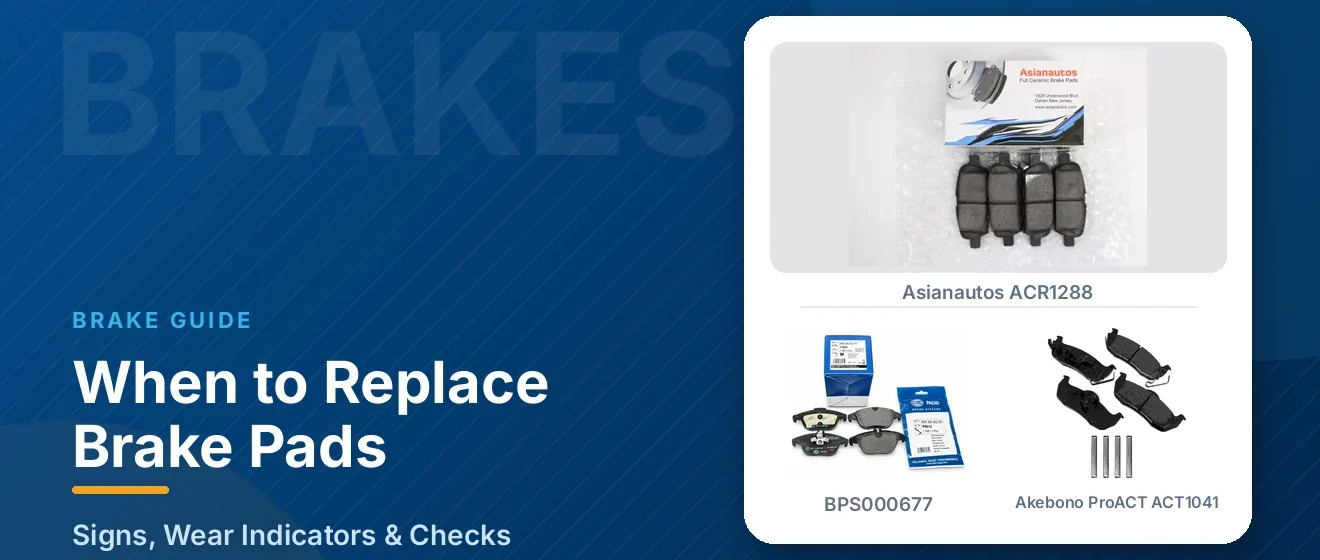
See our disc brake pad sets. Front and rear pads are different parts, so check the position on the listing. Examples from the category:
| Part | Brand | Listed for | Price |
|---|---|---|---|
| Akebono ProACT ACT1697 Ceramic Disc Brake Pad Kit | Akebono | Acura, Honda | $72.13 |
| Asianautos ACR1288 Premium Ceramic Disc Brake Pad Set | Asianautos | INFINITI, Nissan | $24.82 |
| HELLA PAGID BPS000677 Rear Brake Pad Set and Sensor | HELLA PAGID | Mercedes-Benz | $47.25 |
The HELLA PAGID kit includes a pad wear sensor with the pads. Prices may change; the product page shows the current price. “Listed for” shows the makes on each listing. Check the full fitment list for your year, model and axle before ordering, or send us your VIN and our team will confirm fitment. Standard shipping is free to the lower 48 states with no minimum order.
FAQ
Can I keep driving when the pads squeal?
The squeal is an early warning, so you usually have a little time, but book the replacement now. If the squeal turns into grinding, stop driving and have the brakes inspected.
How often should I check my brake pads?
Follow the inspection schedule in your owner’s manual, and look at the pads whenever the wheels are off, for example at a tire rotation.
Should front and rear pads be replaced together?
No, they are judged separately. Wagner notes that the front brakes do most of the work, so the front and rear pads often wear at different rates. Always replace both sides of the same axle together.
For the full picture of pads, rotors, sensors and hardware, read our brake repair guide.
Safety note: Brakes are safety-critical. This guide is general and may not match your vehicle. Follow your vehicle’s service manual and have a qualified technician inspect the brakes if you are unsure. US Automotives is an independent retailer and is not affiliated with any vehicle manufacturer.