
Quick answer: C0035, C0040, C0045 and C0050 are ABS chassis codes for the wheel speed sensor circuits. In the most common definitions they cover the left front, right front, left rear and right rear wheels. The ABS wheel speed sensor at that wheel is the usual part involved, along with its wiring, connector and tone ring.
What C0035 to C0050 mean
These codes come from the ABS (brake) control module, not the engine computer. The most widely used definitions are:
| Code | Common definition |
|---|---|
| C0035 | Left Front Wheel Speed Sensor Circuit |
| C0040 | Right Front Wheel Speed Sensor Circuit |
| C0045 | Left Rear Wheel Speed Sensor Circuit |
| C0050 | Right Rear Wheel Speed Sensor Circuit |
Chassis codes are less standardized than engine codes. The definitions above match GM-family service information, where each code also carries a failure-type suffix. In that information, “06” means low voltage or open, “0F” an erratic signal, “18” low signal amplitude and “5A” not plausible. Other manufacturers may use different numbers for the same fault or give these numbers different meanings. Always go by the description your scan tool shows for your vehicle.
Each wheel has a sensor that reads a toothed or magnetic encoder ring (tone ring) on the hub, axle or CV joint. The ABS module compares the four wheel speeds to detect a wheel about to lock. The same data feeds traction and stability control, and on many vehicles the speedometer and transmission too. Older “passive” sensors generate their own signal. Newer “active” sensors need a supply voltage from the module. In GM-family service information, setting one of these codes turns on the ABS and traction/stability indicators and disables those systems for the rest of the drive.
Symptoms
| Symptom | What’s going on |
|---|---|
| ABS warning light on, often with traction or stability control lights | The module has disabled the systems that depend on wheel speed. |
| Wheels can lock in a hard stop | ABS is off; normal braking without anti-lock control. |
| ABS clicking or pedal pulsing at low speed on dry pavement | An erratic sensor makes the module think a wheel is locking. |
| Hill start assist or other driver aids off | They share the same wheel speed data. |
| Speedometer or shifting problems | On vehicles that take road speed from the ABS sensors. |
| Fault only in rain or after a car wash | Water getting into a damaged wire or connector. |
Likely causes, most to least common
This order reflects how often repair references name each cause. It is not a statistic.
- Wiring or connector damage at the wheel. The harness flexes with every bump and turn and is exposed to water, salt and debris. Broken, chafed or corroded wires are common.
- Failed sensor. Internal short or open, or physical damage.
- Contamination. Metal particles or heavy dirt on the sensor tip or encoder ring, and rust at the mounting point, which can push the sensor away from the ring.
- Damaged tone ring or encoder. Cracked, rusted or missing teeth, or a damaged magnetic encoder. On some vehicles the encoder is part of the wheel bearing or hub.
- Worn wheel bearing. Excess play changes the gap between the sensor and the ring.
- ABS module or its connector. Less common; suspect it after the wiring and sensor test good.
How to diagnose C0035 to C0050, step by step
- Use a scan tool that reads the ABS module. Many basic code readers only talk to the engine computer and won’t show C-codes.
- Record every code, including any suffix. If two or more wheels have codes, check each sensor on its own, but also look at anything they share, such as the module connector, power and ground.
- Compare live wheel speeds. With a helper watching the scan tool, drive straight at low speed in a safe place. All four wheel speeds should match closely. The faulty one drops out, reads zero or jumps around.
- Inspect the harness. Follow the wire from the sensor to the body connector. Check that every clip is in place and look for stretched, chafed or broken wire and corrosion inside the connector. If the fault only happens in wet weather, pay extra attention to the connector seals.
- Inspect the sensor and ring. Remove the sensor and check its tip for damage and metal debris. Look at the tone ring for cracks, rust or missing teeth, and check the wheel bearing for play. Don’t use a magnet to clean a magnetic encoder ring.
- Identify the sensor type before using a meter. A passive sensor’s resistance can be measured and compared with the specification in the service manual for your vehicle. An active sensor’s resistance can’t be measured meaningfully, and a resistance test on one is a common mistake. Instead, check its supply voltage and signal with the wiring diagram and, ideally, an oscilloscope.
- Swap only if parts are identical. Some technicians swap left and right sensors to see if the code follows, but only do this when the parts are truly interchangeable.
- Repair and verify. Clean the mounting bore, fit the sensor, route and clip the cable exactly as original, and tighten to the torque in the service manual. Clear the codes, then test drive while watching all four wheel speeds.
Parts you’ll need
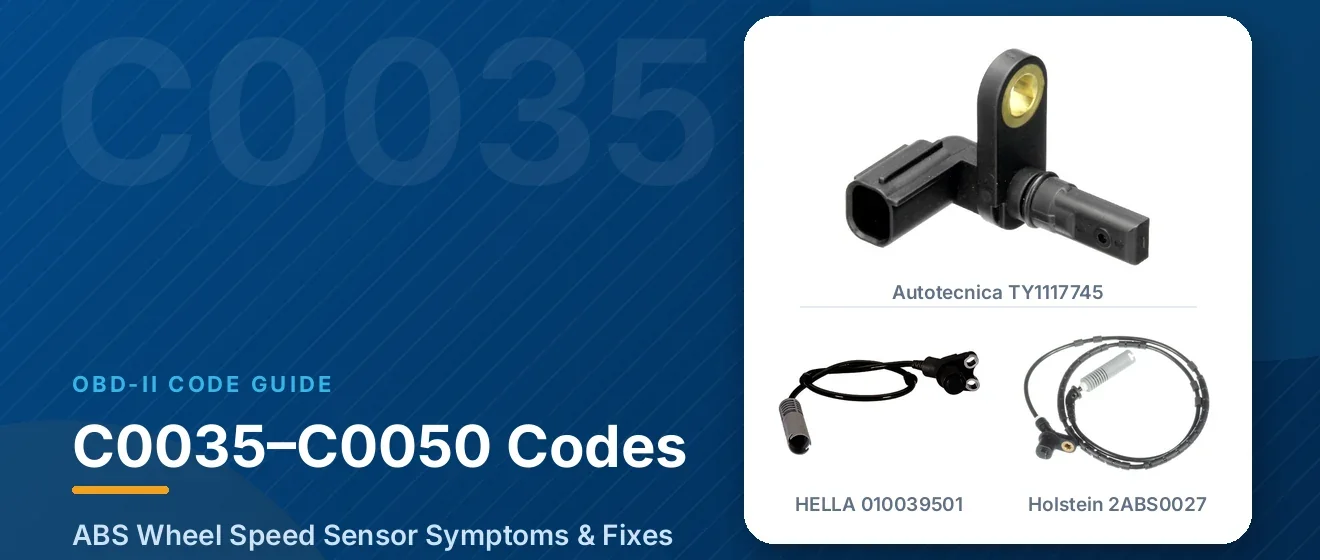
If the sensor is bad, see our ABS wheel speed sensors. Front and rear, and left and right, are often different parts, so check the position on the listing. Examples from the category:
| Part | Brand | Listed for | Price |
|---|---|---|---|
| Autotecnica TY1117745 ABS Speed Sensor | Autotecnica | Toyota | $39.09 |
| Hella 010039501 ABS Wheel Speed Sensor | HELLA | BMW | $63.08 |
| HOLSTEIN 2ABS0027 ABS Wheel Speed Sensor | Holstein | BMW | $34.47 |
If the wiring is the problem, see our ABS wheel speed sensor wiring harnesses, such as the HOLSTEIN 2ABS2479 ABS Wheel Speed Sensor Wiring Harness (listed for Toyota; $34.59).
Prices may change; the product page shows the current price. “Listed for” shows the makes on each listing. Check the full fitment list for your year, model and wheel position before ordering.
FAQ
Is it safe to drive with the ABS light on?
Your regular brakes normally still work, but without anti-lock, traction or stability control. Leave extra stopping distance, especially in the wet. If the red brake warning light is also on, have the brakes checked before driving.
Do I need a new wheel bearing?
Only if the bearing has play or its built-in encoder is damaged. Many wheel speed codes are fixed with a sensor or wiring repair alone.
Why did the code come back after a new sensor?
Look at the harness, the connector, the tone ring, rust under the sensor, or a sensor fitted to the wrong wheel position.
Will the ABS light go off by itself?
On some vehicles the light goes out once the module sees good signals on a test drive. Others need the code cleared with an ABS-capable scan tool. Either way, confirm all four wheel speeds read correctly.
Safety note: This diagnosis guidance is general and may not match your vehicle. Confirm the fault with a qualified technician before replacing parts. US Automotives is an independent retailer and is not affiliated with any vehicle manufacturer.