
Quick answer: P0335 means the engine computer is not getting a usable signal from the crankshaft position (CKP) sensor circuit. P0336 means a signal is there but drops out or doesn’t match the expected pattern. The crankshaft position sensor is the usual suspect, but wiring, connectors and the toothed reluctor ring set the same codes.
What P0335 and P0336 mean
Both are generic OBD-II powertrain codes from the SAE J2012 list, so they apply to most gasoline cars and light trucks sold in the US since 1996. The generic definitions are:
| Code | Generic definition | In plain English |
|---|---|---|
| P0335 | Crankshaft Position Sensor “A” Circuit | The computer sees no crank pulses, or the circuit is open or shorted. |
| P0336 | Crankshaft Position Sensor “A” Circuit Range/Performance | Pulses arrive, but they drop out, even briefly, or don’t make sense. |
The CKP sensor reads a toothed wheel (reluctor or encoder ring) on the crankshaft, harmonic balancer or flywheel. The engine computer uses that signal for engine speed, ignition and injection timing, and misfire detection. Older code lists word P0335 as “Circuit Malfunction.” Some engines have a second crank sensor, labeled “B,” with its own codes (P0385 and up). Manufacturers also set their own enable conditions and sometimes add sub-codes, so always read the description your scan tool shows for your vehicle.
Symptoms
| Symptom | What’s usually going on |
|---|---|
| Engine cranks but won’t start | On many engines, no crank signal means no spark and no injector pulse. |
| Intermittent stalling, sometimes with no restart until it cools | A sensor or connection that drops out when hot is a commonly reported pattern. |
| RPM reads zero on the tachometer or scan tool while cranking | The computer isn’t seeing crank pulses. |
| Rough running, misfire or hesitation | An erratic signal upsets timing and misfire monitoring. |
| Check engine light with no other symptoms | On some engines the sensor is used mainly for misfire detection, so the car runs normally. Some vehicles need several drive cycles before the light comes on. |
Likely causes, most to least common
This order reflects how often repair references point to each cause. It is not a statistic, and your vehicle may differ.
- Failed crankshaft position sensor. Internal shorts and heat-related failures are typical. A sensor that quits when hot and works again when cold is a strong clue.
- Wiring or connector faults. Chafed or melted insulation, an oil-soaked or corroded connector, a broken locking tab, or a loose terminal. Wiring routed too close to spark plug wires can also pick up interference.
- Reluctor ring problems. Missing or broken teeth, debris lodged in the ring, or a ring that has come loose. Magnetic sensors can also collect metal particles on the tip.
- Incorrect sensor gap or installation. A sensor that isn’t fully seated, or a wrong part, can read poorly even when new.
- Mechanical faults. A broken timing belt, or a sheared crankshaft key that lets the reluctor stop turning with the crank.
- Engine computer (PCM/ECM) fault. Possible but rare. Rule out everything else first.
How to diagnose P0335 or P0336, step by step
- Read all codes and freeze-frame data. Note engine temperature, rpm and whether the engine was cranking or running when the code set. Also note any camshaft sensor codes (P0340 series) or cam/crank correlation codes (P0016 to P0019). Several sensor codes at once can point to a shared wiring or power problem, while correlation codes can point to timing.
- Check for an rpm signal while cranking. If the scan tool shows zero rpm while the engine turns over, the computer isn’t seeing the crank signal.
- Find the sensor. Depending on the engine it may be at the front near the balancer, on the side of the block, or near the flywheel at the back of the engine. Your service manual shows the location.
- Inspect the wiring and connector. Look for chafing, melted insulation, oil inside the connector, bent or pushed-back pins and a broken lock. Check that the harness is clipped in place and routed away from spark plug wires and hot exhaust parts.
- Do a wiggle test. With the engine idling (if it runs), or while a helper cranks it, gently flex the harness and connector while watching rpm in live data. A dropout or stall points to wiring.
- Identify the sensor type before using a meter. Two-wire sensors are usually magnetic (inductive). Three-wire sensors are often Hall-effect. Sensor maker HELLA warns that an ohmmeter’s test current can destroy a Hall sensor, so don’t ohm-test one. For a magnetic sensor, compare the resistance with the specification in the service manual for your vehicle. For a Hall sensor, check its supply, ground and signal using the manual’s procedure. An oscilloscope gives the clearest answer for either type.
- Check the circuit. With the battery disconnected and the wiring diagram in hand, check continuity from the sensor connector to the engine computer connector, and check each wire for shorts to ground and to voltage.
- Remove and inspect the sensor and ring. Look for a damaged or rubbed tip and metal debris. If you can see the reluctor ring, check it for missing teeth and looseness. On some engines the ring sits inside the transmission bell housing, which is a job for a shop.
- On timing-belt engines with a no-start, confirm the belt is intact before condemning the sensor.
- Replace, clear and verify. Fit the correct sensor, clear the codes and confirm a steady rpm signal. Some engines need a relearn afterward. Certain GM engines, for example, call for a crankshaft position variation learn with a scan tool after the sensor is replaced. Check the service manual for your vehicle.
Parts you’ll need
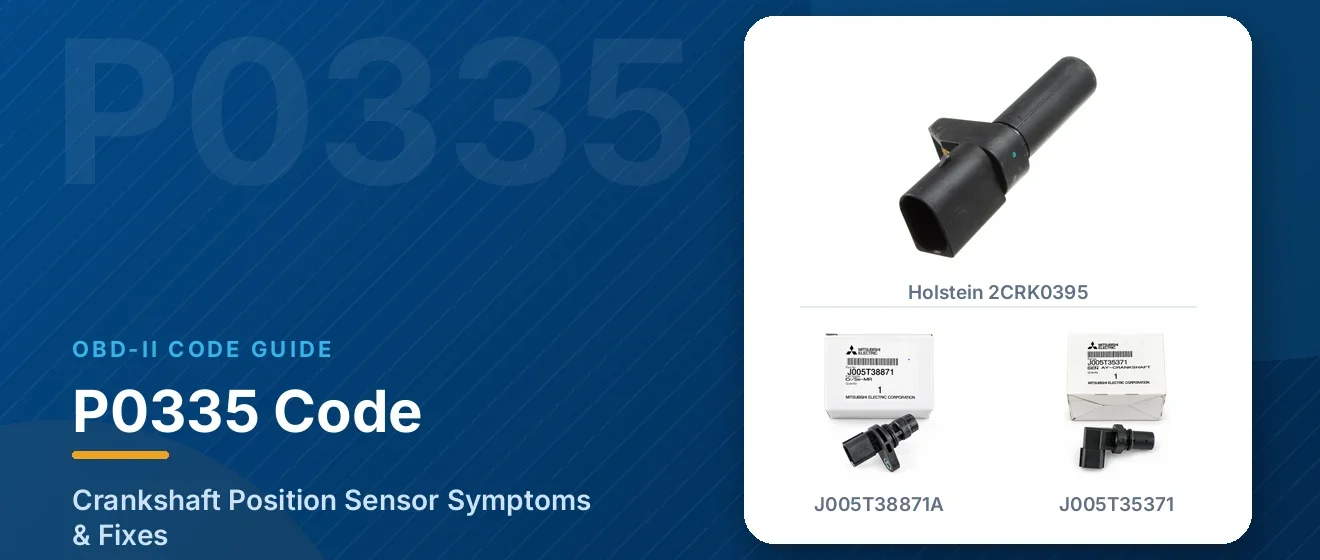
If testing confirms a bad sensor, browse our engine crankshaft position sensors. Crank sensors are often specific to engine and model year, so match the part to your vehicle’s fitment list rather than its appearance. A few examples from the category:
| Part | Brand | Listed for | Price |
|---|---|---|---|
| HOLSTEIN 2CRK0395 Engine Crankshaft Position Sensor | Holstein | Mercedes-Benz | $30.58 |
| Mitsubishi Electric J005T38871A OEM Crankshaft Position Sensor | Mitsubishi Electric | Mitsubishi | $40.45 |
| Mitsubishi Electric J005T35371 OEM Engine Crankshaft Position Sensor | Mitsubishi Electric | Subaru | $36.60 |
Prices may change; the product page always shows the current price. “Listed for” shows the makes on each listing. Check the full fitment list for your year, model and engine before you order. If the fault turns out to be wiring or a connector, repair that instead. A new sensor won’t fix a broken wire.
FAQ
Can I drive with a P0335 code?
If the engine runs, it may still stall without warning, including in traffic. If you’re getting stalls or hard starts, get the car diagnosed before relying on it.
Will a new crank sensor always fix P0335?
No. Damaged wiring, a bad connector or a damaged reluctor ring set the same code. Test before you buy, and inspect the harness while the old sensor is out.
What’s the difference between P0335 and P0340?
P0335 is the crankshaft position sensor circuit; P0340 is the camshaft position sensor circuit. They sometimes appear together when a shared wire, connector or power supply fails, or when there’s a timing problem.
Do I have to do anything after replacing the sensor?
Clear the codes and confirm the repair. Some vehicles also need a scan-tool relearn, so check the service manual for your vehicle.
Safety note: This diagnosis guidance is general and may not match your vehicle. Confirm the fault with a qualified technician before replacing parts. US Automotives is an independent retailer and is not affiliated with any vehicle manufacturer.