
Quick answer: P0340 means the engine computer has found a problem in the camshaft position sensor “A” circuit, usually a missing or electrically faulty signal. P0341 means the signal is present but doesn’t make sense. The camshaft position (CMP) sensor is the usual part involved, but wiring, connectors and timing problems cause both codes.
What P0340 and P0341 mean
Both are generic OBD-II powertrain codes from the SAE J2012 list, used by most makes since 1996:
| Code | Generic definition | In plain English |
|---|---|---|
| P0340 | Camshaft Position Sensor “A” Circuit (Bank 1 or Single Sensor) | No cam signal, or an open or short in the circuit. |
| P0341 | Camshaft Position Sensor “A” Circuit Range/Performance (Bank 1 or Single Sensor) | A cam signal arrives, but it’s inconsistent with what the computer expects. |
The cam sensor reads a toothed target on the camshaft. Working with the crankshaft sensor, it tells the computer when cylinder 1 is at top dead center on its compression stroke. The computer uses that for injector timing, coil firing and, on many engines, variable valve timing. Engines with more than one cam sensor use other codes for the other sensors. Some manufacturers use “A” for the intake cam and “B” for the exhaust cam, but labeling varies. Older code lists word P0340 as “Circuit Malfunction.” Check the exact description your scan tool shows.
Symptoms
| Symptom | What’s usually going on |
|---|---|
| Long cranking before it starts, or no start | Many engines can start on the crank signal alone after extra cranking. Some won’t start at all without a cam signal. |
| Stalling, sometimes followed by a no-restart | The signal drops out while driving. |
| Rough running, misfire, hesitation, weak acceleration | Injection and spark timing are off, or the computer is running a backup strategy. |
| Poor fuel economy | The computer may fall back to less precise fuel control. |
| Check engine light only | Common with P0341 when the engine still runs normally. |
Likely causes, most to least common
The order below reflects how often repair references point to each cause. It is not a statistic.
- Failed camshaft position sensor. Repair references most often name this, but test it before replacing it.
- Wiring or connector faults. Broken, chafed or shorted wires, or a corroded or oil-soaked connector. Wiring routed too close to coils or spark plug wires can pick up interference and set P0341.
- Crankshaft sensor or crank circuit problem. The computer compares the two signals, so a crank-side fault can show up as a cam code.
- Damaged reluctor (target) wheel on the camshaft or cam gear.
- Timing problems. A stretched timing chain, worn guides or a belt that has jumped a tooth. This usually comes with cam/crank correlation codes (P0016 to P0019).
- Extended cranking. P0341 can set after a long crank, for example while chasing a different no-start problem.
- Engine computer (PCM/ECM). Rare. Rule out everything else first.
How to diagnose P0340 or P0341, step by step
- Read every stored code and the freeze-frame data. If crankshaft sensor codes or correlation codes (P0016 to P0019) are also present, diagnose those alongside the cam code. Correlation codes point toward timing rather than the sensor.
- Clear the codes and see what returns. If P0341 appeared after a long crank, it may not come back once the original problem is fixed.
- Locate the sensor using the service manual. It is usually on the cylinder head, the timing cover or near the end of the camshaft.
- Inspect the connector and harness. Look for oil inside the connector, green or white corrosion, bent pins, a broken lock and chafed or melted insulation. Make sure the wiring isn’t touching or running beside coils or plug wires.
- Do a wiggle test. With the engine idling, flex the harness and connector gently. A stumble or stall points to a wiring fault.
- Check power, ground and signal. Most cam sensors are three-wire Hall-effect types. With the wiring diagram, confirm the reference voltage and ground at the connector with the key on, and check the signal wire for continuity back to the computer. Use the values in the service manual for your vehicle. Don’t ohm-test a Hall sensor; the meter’s current can damage it. With an oscilloscope, a working Hall sensor shows a clean square wave with the engine running.
- Remove and inspect the sensor. Check the tip for damage or debris. If you can see the target wheel through the mounting hole, check it for damaged or missing teeth.
- If the sensor and circuit test good and correlation codes are present, have the cam timing checked. That is often an involved job and is usually best left to a shop.
- Replace, clear and verify. Fit the correct sensor for your engine and position, clear the codes and road test to confirm they don’t return.
Parts you’ll need
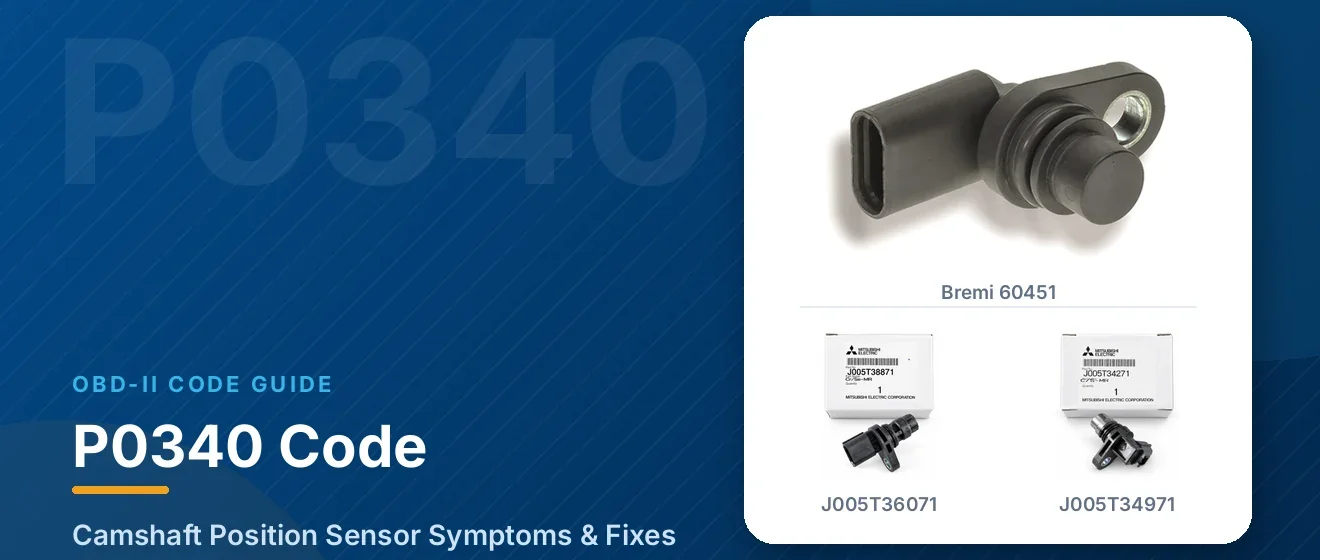
If testing points to the sensor, start with our engine camshaft position sensors. Some engines use several cam sensors that look alike, so confirm which bank and cam (intake or exhaust) the code refers to before ordering. Examples from the category:
| Part | Brand | Listed for | Price |
|---|---|---|---|
| Bremi 60451 Camshaft Sensor | Bremi | Mercedes-Benz, INFINITI | $27.30 |
| Mitsubishi Electric J005T36071 OEM Engine Camshaft Position Sensor | Mitsubishi Electric | Subaru | $41.88 |
| Mitsubishi Electric J005T34971 OEM Camshaft Position Sensor | Mitsubishi Electric | Mazda | $33.79 |
Prices may change; the product page always shows the current price. “Listed for” shows the makes on each listing. Check the full fitment list for your year, model and engine before ordering. If your problem is a damaged connector or wire, repair that rather than replacing a good sensor.
FAQ
Is it safe to drive with P0340?
The engine often keeps running, but it can stall and may not restart. Get it diagnosed promptly rather than relying on the car for long trips.
Should I replace the cam and crank sensors together?
Not without testing. Both codes can come from one shared wiring or power fault, and replacing good sensors won’t fix that.
Why did P0340 come back after I replaced the sensor?
The usual reasons are a wiring or connector fault, a damaged target wheel, a timing problem, or a part that doesn’t match your engine or sensor position.
What’s the difference between P0340 and P0341?
P0340 is an electrical circuit fault, usually no signal at all. P0341 means a signal is present but out of range or inconsistent with the crankshaft signal.
Safety note: This diagnosis guidance is general and may not match your vehicle. Confirm the fault with a qualified technician before replacing parts. US Automotives is an independent retailer and is not affiliated with any vehicle manufacturer.