
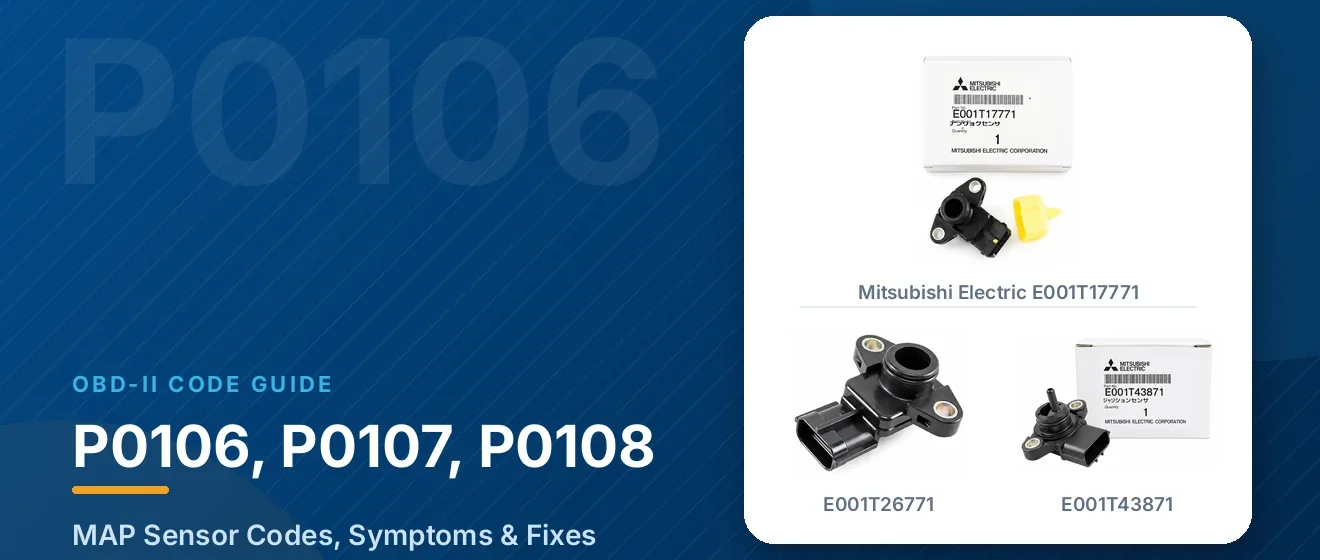
Quick answer: P0106, P0107 and P0108 are manifold absolute pressure (MAP) sensor circuit codes. P0106 means the reading doesn’t fit what the engine is doing, P0107 means the signal voltage is too low, and P0108 means it’s too high. The MAP sensor is the usual part, but vacuum leaks and wiring faults are common causes.
What these codes mean
All three are generic OBD-II powertrain codes from the SAE J2012 list:
| Code | Generic definition | In plain English |
|---|---|---|
| P0106 | Manifold Absolute Pressure/Barometric Pressure Circuit Range/Performance | The MAP reading changes (or doesn’t) in a way that doesn’t match throttle, rpm and other inputs. |
| P0107 | Manifold Absolute Pressure/Barometric Pressure Circuit Low Input | Signal voltage is below the expected range. |
| P0108 | Manifold Absolute Pressure/Barometric Pressure Circuit High Input | Signal voltage is above the expected range, or higher than expected for the conditions. |
The MAP sensor measures pressure (vacuum) in the intake manifold after the throttle. The computer uses it, together with intake air temperature, to work out engine load and how much fuel to inject. Most MAP sensors get a 5-volt reference and a ground from the computer and send back a signal voltage that changes with pressure. Some vehicles also use a mass airflow (MAF) sensor, with the MAP as a backup. Some engines combine manifold pressure and intake air temperature in one sensor. Manufacturers word these codes slightly differently and set their own thresholds, so go by your scan tool’s description. Related codes are P0105 and P0109.
Symptoms
| Symptom | Why it happens |
|---|---|
| Rough or unstable idle, stalling, engine won’t idle | The computer is calculating the wrong load and fuel at idle. |
| Black smoke, poor fuel economy | A false high-load reading makes the engine run rich. |
| Loss of power, hesitation or misfire on acceleration | Fuel and timing don’t match the real load. |
| Hard starting, long cranking | Common with P0107, when the signal reads very low. |
| Check engine light only | Sometimes the only sign, especially with an intermittent fault. |
Likely causes, most to least common
This order reflects how often repair references list each cause. It is not a statistic.
- Vacuum problems. A cracked, clogged or disconnected hose to the sensor (on hose-fed sensors), a blocked sensor port, or an engine vacuum leak. A break in the intake ducting can also upset the readings.
- Wiring and connector faults. An open or short in the 5-volt reference, signal or ground wire, water or dirt in the connector, or a corroded ground.
- Failed MAP sensor. Damaged sensing element or internal short.
- Another sensor dragging down the shared 5-volt reference. On some vehicles several sensors share one reference circuit, so a shorted sensor elsewhere can set P0107.
- Low engine vacuum from a mechanical problem. A worn engine, a restricted exhaust or clogged catalytic converter, or EGR and PCV faults can make the reading look wrong to the computer.
- Weather and model-specific issues. Repair references note service bulletins for MAP sensor corrosion on some Mazda models and for moisture freezing inside the sensor on some GM trucks. Check for bulletins on your vehicle.
- Engine computer. Rare; don’t assume it until everything else checks out.
How to diagnose a MAP sensor code, step by step
- Scan for all codes and record freeze-frame data. Diagnose misfire, EGR, airflow and fuel trim codes too, because they can cause or be caused by a bad MAP reading.
- Compare MAP and BARO with the key on and engine off. With the engine stopped, the manifold is at atmospheric pressure, so the scan tool’s MAP and barometric readings should be roughly the same. A big difference points to the sensor or its circuit.
- Start the engine and watch the MAP reading. It should drop clearly at idle (more vacuum) and rise quickly when you blip the throttle. A reading that doesn’t move, or moves slowly, needs investigating.
- Inspect the vacuum side. If the sensor has a hose, check it for cracks, kinks, softness and blockage, and make sure the port isn’t plugged. Listen for hissing around the intake. A smoke test is the most reliable way to find small leaks.
- Test the sensor with a hand vacuum pump. Apply vacuum to the sensor port and watch the scan tool or a voltmeter. The reading should change smoothly as vacuum changes. If it doesn’t, and the port is clear, the sensor is likely bad.
- Check the circuit. Unplug the sensor and, with the key on, check for the reference voltage and a good ground at the connector, using the values and pin-out in the service manual for your vehicle. If the reference is missing, check whether another sensor on the same reference is pulling it down by unplugging them one at a time.
- Wiggle-test the harness with the engine running and watch for jumps in the MAP reading.
- If you suspect low engine vacuum, have a technician check engine vacuum and exhaust back-pressure before replacing parts.
- Replace, clear and verify. Fit the correct sensor, reconnect any hose securely, clear the codes and confirm the readings on a test drive.
Parts you’ll need
If the sensor fails the tests, see our manifold absolute pressure (MAP) sensors. Examples from the category:
| Part | Brand | Listed for | Price |
|---|---|---|---|
| Mitsubishi Electric E001T17771 OEM Manifold Absolute Pressure Sensor | Mitsubishi Electric | Mitsubishi | $39.93 |
| Mitsubishi Electric E001T26771 OEM Manifold Absolute Pressure Sensor | Mitsubishi Electric | Suzuki | $30.01 |
| Mitsubishi Electric E001T43871 OEM Manifold Absolute Pressure Sensor | Mitsubishi Electric | Mitsubishi | $39.60 |
Prices may change; check the product page for the current price. “Listed for” shows the makes on each listing. Check the full fitment list for your year, model and engine before ordering. If the problem is a cracked hose or a vacuum leak, fix that first. A new sensor won’t cure it.
FAQ
Can I clean a MAP sensor?
You can clear a blocked port or replace a cracked hose, and that sometimes fixes the code. If the sensor still fails the vacuum-pump test, replace it.
What’s the difference between a MAP and a MAF sensor?
A MAP sensor measures pressure in the intake manifold; a MAF sensor measures the airflow entering the engine. Some vehicles use one, some use both.
Is it safe to drive with P0106, P0107 or P0108?
Many cars still drive, but they may run rich, stall or lose power. Get it diagnosed soon, especially if the engine stalls or backfires.
Will the code clear itself?
An intermittent fault may turn the light off after several good drive cycles, but the cause is still there. Find and fix it.
Safety note: This diagnosis guidance is general and may not match your vehicle. Confirm the fault with a qualified technician before replacing parts. US Automotives is an independent retailer and is not affiliated with any vehicle manufacturer.