
Quick answer: P0401 means the engine computer detected too little exhaust gas recirculation (EGR) flow, P0402 means too much, and P0404 means the EGR valve’s position doesn’t match what the computer commanded. The EGR valve is the part most often involved. Carbon-clogged passages, flow sensors and vacuum controls also cause these codes.
What P0401, P0402 and P0404 mean
All three are generic OBD-II powertrain codes from the SAE J2012 list:
| Code | Generic definition | In plain English |
|---|---|---|
| P0401 | Exhaust Gas Recirculation Flow Insufficient Detected | Less exhaust gas is getting back to the intake than expected. |
| P0402 | Exhaust Gas Recirculation Flow Excessive Detected | More exhaust gas is flowing than expected, often from a valve that isn’t closing. |
| P0404 | Exhaust Gas Recirculation “A” Circuit Range/Performance | The valve’s reported position doesn’t match the commanded position. |
The EGR system routes a metered amount of exhaust gas back into the intake. This lowers combustion temperature and cuts oxides of nitrogen (NOx) emissions. Older systems use a vacuum-operated valve controlled by a solenoid. Newer systems use an electric valve that reports its own position to the computer. Makers measure EGR flow in different ways. Many older Ford systems, for example, use a differential pressure feedback (DPFE) sensor. That’s why the same code can have different root causes on different vehicles. Always read your scan tool’s exact description and check the service manual.
Symptoms
| Symptom | Most often seen with |
|---|---|
| Check engine light with no drivability change | All three codes; very common |
| Pinging (spark knock) under load or acceleration | P0401, as combustion runs hotter without EGR |
| Rough idle, stalling, surging off idle | P0402 and P0404, when the valve is stuck partly open |
| Hesitation or jerking on acceleration, poor performance | Any EGR fault |
| Failed emissions inspection, higher NOx | Any EGR fault |
| Black smoke | Mainly diesels with EGR faults |
Likely causes, most to least common
The order reflects how often repair references name each cause. It is not a statistic.
- Carbon buildup in EGR passages, ports or tubes. Soot and oil mist gradually narrow the passages. Some Honda engines (the F-series four-cylinders and J-series V6s) are well known among technicians for clogged EGR ports in the intake manifold.
- Faulty EGR valve. Stuck closed (P0401), stuck open (P0402), or carbon-jammed with a failing motor or position sensor (P0404).
- Flow-sensor problems. On systems that use one, a failed DPFE sensor or its cracked, collapsed or swapped hoses are a frequent cause of P0401. NAPA’s guidance on Ford P0401 codes names the DPFE sensor as the most common issue.
- Vacuum supply and control faults. Leaking or disconnected vacuum hoses, or a failed EGR control solenoid, can keep a vacuum valve from opening.
- Wiring faults. An open or short in the reference, ground or control circuit of an electric valve.
- Engine computer. Uncommon.
How to diagnose an EGR code, step by step
- Read all codes and freeze-frame data. Misfire codes alongside P0401 can point to clogged EGR runners feeding some cylinders more than others.
- Check for technical service bulletins. Some makes have bulletins for clogged EGR ports or updated parts.
- Do a visual inspection. Check vacuum hoses for cracks and correct routing, check DPFE or pressure sensor hoses where fitted, and check the valve’s electrical connector.
- Test valve operation.
- Vacuum-operated valve: With the engine warm and idling, apply vacuum to the valve with a hand pump. The idle should stumble noticeably or the engine may stall. If nothing changes, the valve is stuck or the passages are blocked. Also check that the diaphragm holds vacuum.
- Electric valve: Use a scan tool with bidirectional control to command the valve open and closed. Compare commanded and actual position. At idle, commanding it open should make the engine stumble.
- Check the circuit on electric valves. Using the wiring diagram, confirm the reference voltage, ground and control signal at the connector against the values in the service manual for your vehicle.
- Remove and inspect. Take the valve off and look at the pintle, seat and port for carbon. HELLA notes that a valve can be heavily contaminated even when it passes an actuator test, so a visual check is worthwhile.
- Clean or replace. If the passages are clogged, cleaning them may fix P0401 on its own. If the valve sticks, leaks vacuum or reports the wrong position, replace it. Always fit a new gasket.
- Clear and verify. The EGR monitor only runs under certain driving conditions. Drive normally and check that the monitor completes and the code doesn’t return.
Parts you’ll need
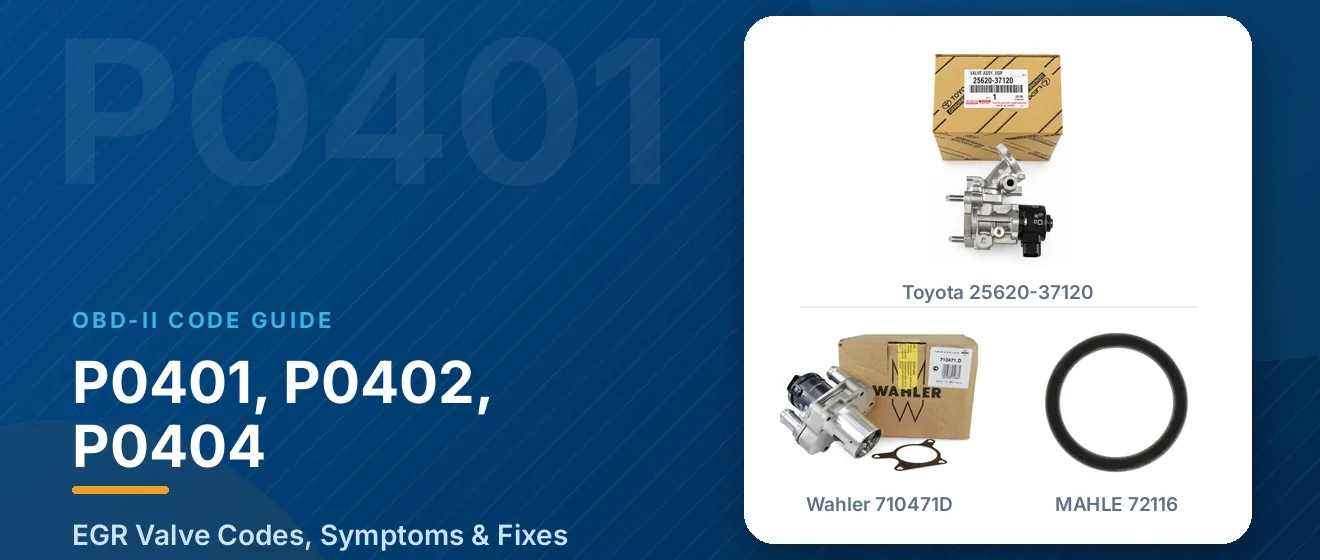
If the valve is at fault, see our exhaust gas recirculation (EGR) valves. Our selection is small right now; these are the valves currently listed:
| Part | Brand | Listed for | Price |
|---|---|---|---|
| Toyota 2562037120 EGR Valve | Toyota | Toyota, Lexus | $219.11 |
| Wahler 710471D OEM EGR Valve | Wahler | Freightliner, Mercedes-Benz | $307.40 |
Whenever an EGR valve comes off, it needs a fresh gasket. See our EGR valve gaskets, including the MAHLE 72116 EGR Valve Gasket (listed for Pontiac, Chevrolet, Oldsmobile and Buick; $48.88).
Prices may change; the product page shows the current price. “Listed for” shows the makes on each listing. Check the full fitment list for your year, model and engine before ordering. If cleaning the passages or replacing a sensor hose fixes the code, you may not need a valve at all.
FAQ
Can I clean an EGR valve instead of replacing it?
Often, yes. P0401 is frequently caused by carbon in the passages, and cleaning can fix it. A valve with a failed motor, position sensor or leaking diaphragm needs replacing.
Is it safe to drive with an EGR code?
Usually for a short time. But a valve stuck open can make the engine stall at stops, and ongoing pinging under load is worth taking seriously. Get it fixed soon.
Will an EGR code fail an emissions test?
In most areas with OBD-II emissions inspections, a lit check engine light is a fail, so plan to fix it before your inspection.
Why does P0401 keep coming back after a new valve?
The usual culprits are clogged passages or ports that were never cleaned, a failed DPFE or pressure sensor, cracked sensor hoses, or a vacuum supply problem.
Safety note: This diagnosis guidance is general and may not match your vehicle. Confirm the fault with a qualified technician before replacing parts. US Automotives is an independent retailer and is not affiliated with any vehicle manufacturer.