
Quick answer: P0500 means the engine computer isn’t getting a valid vehicle speed signal. The signal may be missing, erratic or different from what it expects. The vehicle speed sensor (VSS), usually on the transmission or transaxle, is the most common part involved. Wiring faults, and on some vehicles ABS wheel speed sensors, can also cause it.
What P0500 means
P0500 is a generic OBD-II powertrain code from the SAE J2012 list, defined as Vehicle Speed Sensor “A” (older lists say “Vehicle Speed Sensor Malfunction”). The computer sets it when the speed signal is absent or doesn’t make sense compared with other inputs such as engine rpm, gear and load. Related codes:
| Code | Generic definition |
|---|---|
| P0500 | Vehicle Speed Sensor “A” |
| P0501 | Vehicle Speed Sensor “A” Range/Performance |
| P0502 | Vehicle Speed Sensor “A” Circuit Low Input |
| P0503 | Vehicle Speed Sensor “A” Intermittent/Erratic/High |
Where the speed signal comes from depends on the vehicle. On many cars and trucks it’s a magnetic sensor in the transmission housing that reads a toothed ring on the output shaft. Some older designs use a gear-driven sensor. On many newer vehicles, the ABS module calculates speed from the wheel speed sensors and shares it with the engine and transmission computers. The vehicle speed signal feeds the speedometer, shift timing and, on many vehicles, other systems. Manufacturers word the code and its conditions differently, so check the description on your scan tool.
Symptoms
| Symptom | Why it happens |
|---|---|
| Speedometer or odometer erratic or dead | The gauge has no reliable speed input. |
| Harsh, late or erratic automatic shifts | The transmission computer uses road speed to time shifts. |
| ABS or traction control warning lights; ABS disabled | On vehicles where speed and wheel speed data are shared. |
| Lower rev limit than normal | Some computers reduce the rpm limit when road speed is unknown. |
| Check engine light | Always present once the code matures. |
Likely causes, most to least common
This order reflects how often repair references name each cause. It is not a statistic.
- Failed vehicle speed sensor. The most commonly reported cause.
- Wiring or connector damage. Broken, chafed or melted wires near the transmission or exhaust, or a corroded connector.
- Damaged drive gear or reluctor ring that the sensor reads.
- ABS wheel speed sensor or ABS module fault on vehicles that take road speed from the ABS system.
- Tire size mismatch. Tires much larger or smaller than original, or a computer that hasn’t been set up for the actual tire size.
- Instrument cluster, network or engine computer problems. Less common, and best diagnosed with a capable scan tool.
How to diagnose P0500, step by step
- Find out where your vehicle gets its speed signal. The service manual will show whether it’s a transmission VSS, an output shaft speed sensor or the ABS system. This decides which part, if any, you need.
- Scan all modules, not just the engine. ABS codes or transmission speed sensor codes stored at the same time are strong clues. Record the freeze-frame data.
- Check for technical service bulletins. Some makes have known fixes for P0500.
- Clear the code and road test with a helper. Have the passenger watch the vehicle speed reading in live data. It should rise and fall smoothly with the speedometer. A dropout or a reading of zero while moving confirms the fault. Don’t watch the scan tool while you drive.
- Inspect the wiring and connector. Follow the harness from the sensor. Look for chafing, melted insulation near the exhaust, broken wires and corrosion in the connector.
- Test the sensor circuit. Two-wire magnetic sensors produce an AC signal that grows with speed. Three-wire sensors need a supply voltage and ground and produce a square-wave signal. Check them against the procedure and values in the service manual for your vehicle. An oscilloscope shows dropouts best.
- Remove and inspect the sensor. Look for a damaged tip or a coating of metal debris. On gear-driven sensors, check the gear for broken teeth.
- Consider tire size. If the code appeared after a tire or wheel change, confirm the size matches the original or that the computer has been reconfigured.
- Replace, clear and verify. Fit the correct sensor, clear codes in all affected modules and road test to confirm.
Parts you’ll need
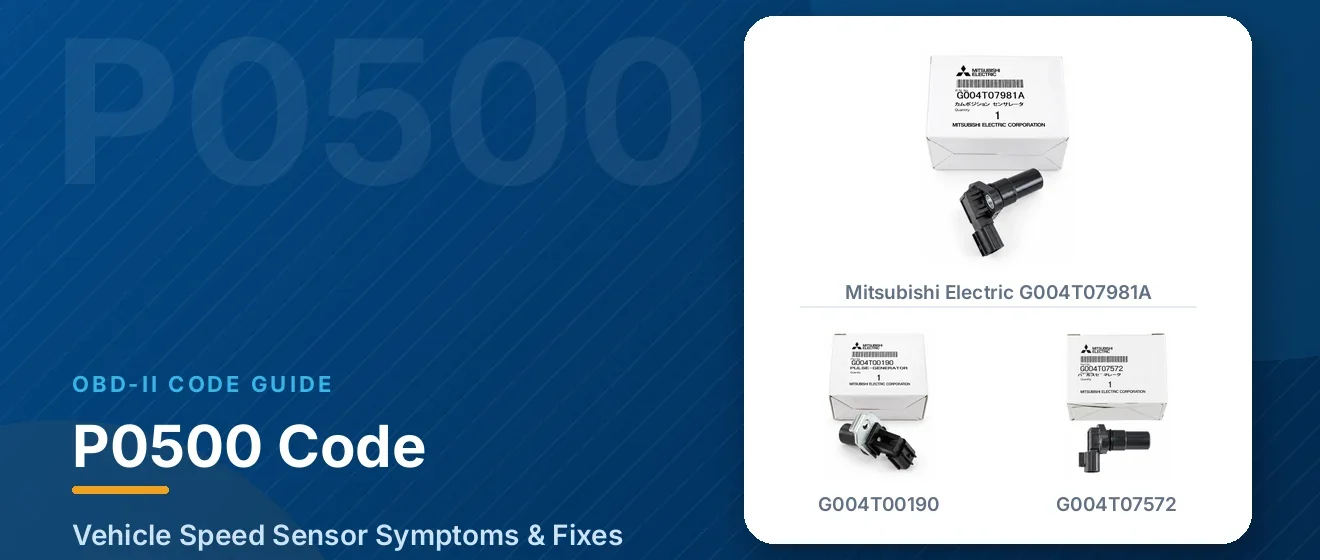
If testing points to the sensor, see our vehicle speed sensors. Examples from the category:
| Part | Brand | Listed for | Price |
|---|---|---|---|
| Mitsubishi Electric G004T07981A OEM Vehicle Speed Sensor | Mitsubishi Electric | Subaru | $32.81 |
| Mitsubishi Electric G004T00190 OEM Vehicle Speed Sensor | Mitsubishi Electric | Mazda | $24.55 |
| Mitsubishi Electric G004T07572 OEM Transmission Speed Sensor | Mitsubishi Electric | Subaru | $32.23 |
Prices may change; check the product page for the current price. “Listed for” shows the makes on each listing. Check the full fitment list for your year, model and transmission before ordering. Many vehicles have more than one speed sensor, so confirm with the service manual which one supplies the signal behind your code. If your vehicle takes speed from the ABS system, the fix may be an ABS wheel speed sensor instead.
FAQ
Is it safe to drive with P0500?
The engine usually runs, but shifting may be rough, the speedometer may be wrong, and ABS or traction control may be off. Drive carefully, especially in wet weather, and get it repaired.
Can a bad ABS sensor cause P0500?
Yes, on vehicles that calculate road speed from the wheel speed sensors. Check for ABS codes at the same time.
Can bigger tires cause P0500?
A tire size the computer isn’t set up for can make the speed signal look wrong. If the code started after new tires or wheels, check that first.
I replaced the sensor and the speedometer still doesn’t work. Why?
Look at the wiring, the drive gear or reluctor ring, the instrument cluster, or whether you replaced the sensor that actually supplies the speed signal.
Safety note: This diagnosis guidance is general and may not match your vehicle. Confirm the fault with a qualified technician before replacing parts. US Automotives is an independent retailer and is not affiliated with any vehicle manufacturer.