
Quick answer: P0325 means the engine computer has detected a fault in the knock sensor 1 circuit (bank 1, or the only knock sensor). P0330 is the same fault for knock sensor 2 on bank 2. The knock sensor or its wiring is usually to blame. On many V6 and V8 engines, both sensors sit under the intake manifold.
What P0325 and P0330 mean
Both are generic OBD-II powertrain codes from the SAE J2012 list:
| Code | Generic definition | Which sensor |
|---|---|---|
| P0325 | Knock Sensor 1 Circuit (Bank 1 or Single Sensor) | The bank 1 sensor, or the only sensor on engines with one |
| P0330 | Knock Sensor 2 Circuit (Bank 2) | The sensor on bank 2 of a V-type engine |
A knock sensor is a piezoelectric “microphone” bolted to the engine block. It picks up the vibration of detonation (spark knock) and sends a voltage signal to the engine computer, which retards ignition timing until the knock stops. Bank 1 is the side of the engine with cylinder 1. Manufacturers label banks differently, so check your service manual.
These are circuit codes. They mean the signal is missing or outside the electrical range the computer expects. They don’t mean the engine is knocking. While the code is set, many engines fall back to a safer, retarded ignition timing, which costs power and fuel economy. Related codes in the P0326 to P0334 range cover signal range and high/low faults for the same sensors.
Symptoms
| Symptom | Why it happens |
|---|---|
| Check engine light, often with no other symptoms | The computer flags the circuit fault and switches to a backup strategy. |
| Reduced power, sluggish or hesitant acceleration | Ignition timing is retarded as a precaution. |
| Higher fuel consumption | Retarded timing is less efficient. |
| Pinging or rattling under load | If the sensor can’t report real knock, the computer can’t correct it. |
| Code that comes and goes | Typical of a wiring or connector problem. |
Likely causes, most to least common
Repair sources disagree on whether the sensor or the wiring fails more often, so treat this order as a guide rather than a statistic.
- Wiring and connector damage. Corroded connector pins, chafed or broken wires, and moisture in the connector are common. Sensors in the engine valley are a known target for rodents, and coolant leaks can pool there and corrode the harness.
- Failed knock sensor. Internal short circuit, cracked body or mechanical damage.
- Incorrect mounting. The sensor must sit flat on a clean surface at the specified torque. HELLA notes that washers or spring washers should not be used. A loose or overtightened sensor can misread.
- Engine mechanical noise or a lean mixture. Less common, but excessive engine noise or a running problem can affect the knock signal. Fix any lean or misfire codes first.
- Engine computer software or hardware. Some manufacturers have released software updates for knock sensor codes. A failed computer is rare.
How to diagnose P0325 or P0330, step by step
- Read all codes and the freeze-frame data. Note rpm, load and engine temperature when the code set. Repair any other codes first, especially lean, misfire or camshaft codes.
- Check for technical service bulletins. Some makes have a software update or revised sensor or harness for this code.
- Listen to the engine and check the oil level. Loud mechanical noises such as piston slap or timing chain rattle can confuse the system.
- Clear the code and drive. If it doesn’t return, it may have been a one-off. If it returns quickly, continue.
- Inspect the wiring you can reach. Follow the knock sensor harness from the computer toward the sensor. Look for corrosion, green or white residue, chewed insulation and coolant contamination. If both P0325 and P0330 are set, suspect a shared harness or connector before blaming two sensors.
- Check the circuit with a meter. Using the wiring diagram, check continuity from the sensor connector to the computer connector, and check each wire for a short to ground. Some service manuals also give a sensor resistance specification. Use the value for your vehicle; there is no universal number.
- Check the signal. Some scan tools show knock sensor activity or knock retard in live data. With an oscilloscope on a warm engine, the signal should get noticeably larger when you snap the throttle or lightly tap the engine block near the sensor (not the sensor itself).
- Plan the repair. If the sensor is under the intake manifold, replacing it means removing the intake and fitting new intake gaskets. Many technicians replace the short harness section while they’re in there to avoid doing the job twice.
- Install correctly. Clean the mounting surface, tighten to the torque in the service manual, route the wiring away from hot or moving parts, then clear the codes and road test.
Parts you’ll need
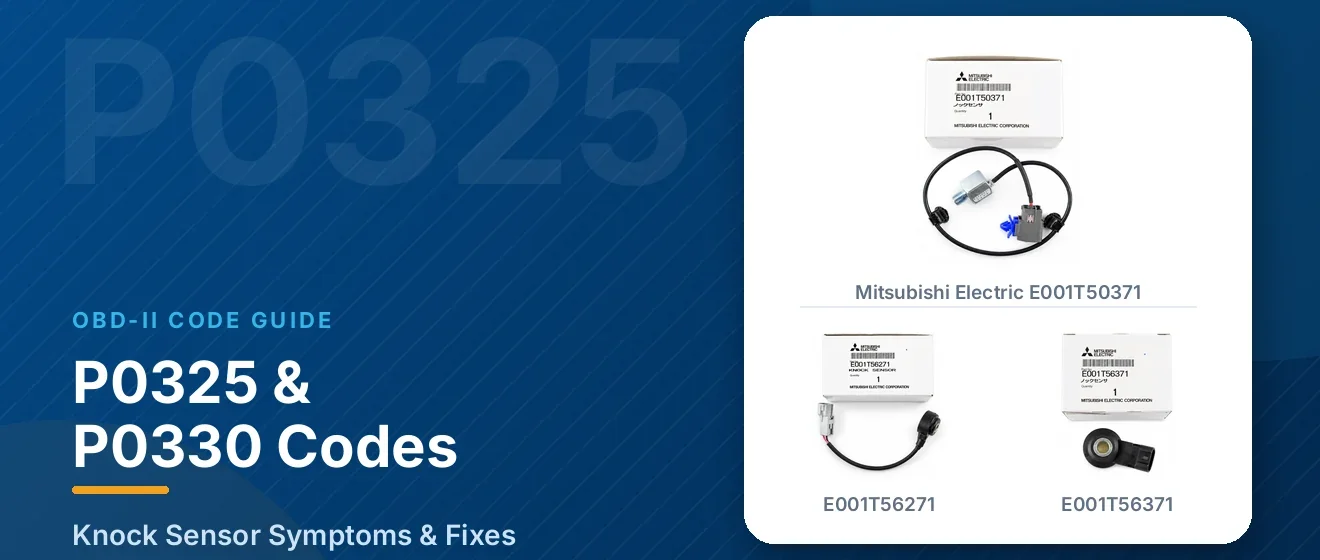
If the sensor tests bad, see our ignition knock (detonation) sensors. On V-engines, the bank 1 and bank 2 sensors may or may not be the same part, so check the listing for your engine. Examples from the category:
| Part | Brand | Listed for | Price |
|---|---|---|---|
| Mitsubishi Electric E001T50371 OEM Ignition Knock (Detonation) Sensor | Mitsubishi Electric | Mazda | $30.68 |
| Mitsubishi Electric E001T56271 OEM Ignition Knock (Detonation) Sensor | Mitsubishi Electric | Suzuki | $29.73 |
| Mitsubishi Electric E001T56371 OEM Knock Sensor | Mitsubishi Electric | Suzuki | $26.84 |
Prices may change; the product page shows the current price. “Listed for” shows the makes on each listing. Check the full fitment list for your year, model and engine before ordering. If the problem is the harness, a new sensor alone won’t fix it.
FAQ
Does P0325 mean my engine is knocking?
Not necessarily. It’s a circuit code, so it usually points to an electrical fault in the sensor or wiring, not to knock itself.
Can I keep driving with a knock sensor code?
Most cars drive with reduced power for a while. But the computer may not be able to detect real knock, so avoid heavy loads, use the fuel grade your owner’s manual specifies, and get it repaired soon.
Should I replace both knock sensors?
Only one may be faulty. But if both sit under the intake manifold, some owners replace both to avoid paying for the same labor twice. Test first and decide.
Why did the code come back after a new sensor?
Common reasons are a damaged harness or connector, incorrect torque or a dirty mounting surface, or a computer software issue covered by a bulletin.
Safety note: This diagnosis guidance is general and may not match your vehicle. Confirm the fault with a qualified technician before replacing parts. US Automotives is an independent retailer and is not affiliated with any vehicle manufacturer.