
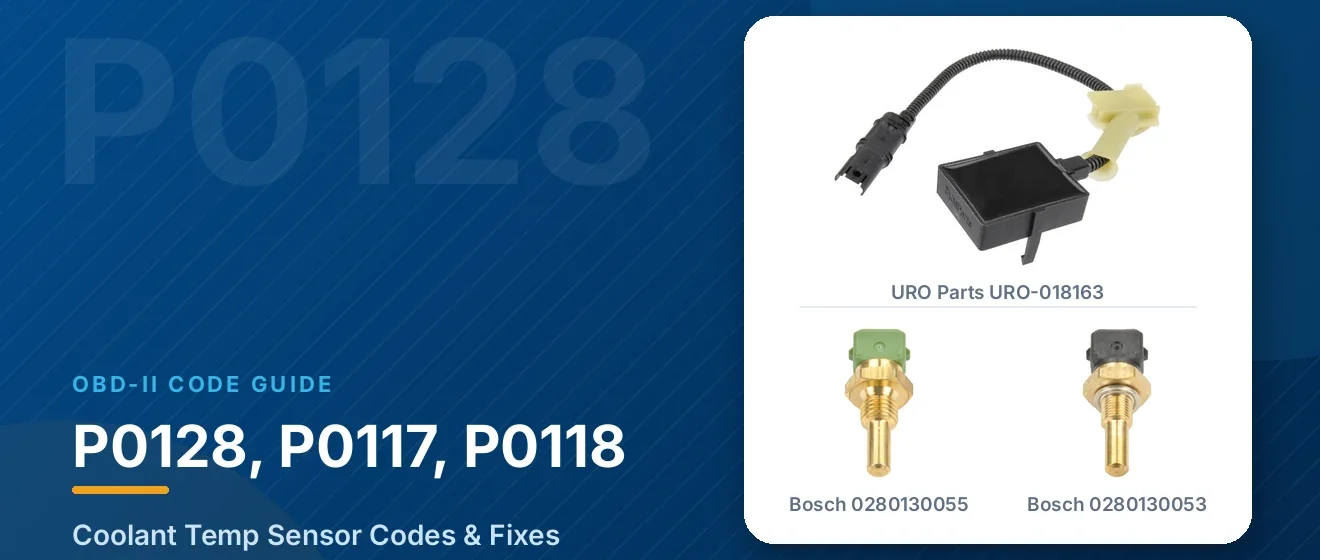
Quick answer: P0128 means the engine took too long to reach its expected operating temperature. It’s most often a thermostat stuck open, sometimes a faulty coolant temperature sensor. P0117 and P0118 mean the engine coolant temperature (ECT) sensor circuit voltage is too low or too high, usually from a failed sensor, connector or wiring.
What P0128, P0117 and P0118 mean
All three are generic OBD-II powertrain codes from the SAE J2012 list:
| Code | Generic definition | What the computer sees |
|---|---|---|
| P0128 | Coolant Thermostat (Coolant Temperature Below Thermostat Regulating Temperature) | Coolant didn’t warm up enough within the expected time. |
| P0117 | Engine Coolant Temperature Sensor Circuit Low Input | Signal voltage is very low, which the computer reads as extremely hot. |
| P0118 | Engine Coolant Temperature Sensor Circuit High Input | Signal voltage is very high, which the computer reads as extremely cold. |
The ECT sensor is a thermistor: its resistance drops as coolant warms. The computer feeds it a reference voltage and reads the voltage across it, so cold coolant gives a high voltage and hot coolant a low one. The reading affects fuel mixture, ignition timing, idle speed and, on many vehicles, the cooling fans. For P0128, the computer also weighs run time, intake air temperature and vehicle speed before deciding the engine is warming up too slowly. Manufacturers word these codes slightly differently, so check the description your scan tool shows.
Symptoms
| Symptom | Most often seen with |
|---|---|
| Slow warm-up, weak heater, temperature gauge reading low or dropping at highway speed | P0128 |
| Check engine light with no other symptoms | P0128 especially |
| Rough running, black smoke, hard starting, stalling after start | P0117 or P0118, because the fuel mixture is based on a false temperature |
| Higher idle speed, poor fuel economy | Any of the three |
| Failed emissions inspection | Any of the three |
Likely causes, most to least common
These lists reflect how often repair references name each cause. They are not statistics.
P0128
- Thermostat stuck or leaking open. The most common fix for this code.
- Low coolant level.
- ECT sensor reading lower than the real temperature.
- Cooling fan running more than it should.
- Intake air temperature sensor fault, since the computer uses it in the warm-up calculation.
- Very cold weather or lots of short trips, which can keep the engine from reaching temperature.
- Engine computer software. Some makes, including Nissan for some models, have released reprogramming for this code. Check for bulletins.
P0117 and P0118
- Failed ECT sensor (internally shorted for P0117, open for P0118).
- Connector problems: corroded, loose or damaged terminals at the sensor or computer.
- Wiring faults: a short to ground (P0117) or an open circuit (P0118).
- Actual overheating can set P0117. Rule this out first.
- Engine computer. Rare.
How to diagnose these codes, step by step
- Safety first. Work on a cold engine. A hot cooling system is pressurized and can cause serious burns, so never open the cap or a hose while it’s hot.
- Check the coolant level and condition with the engine cold, and look for leaks.
- Read codes and freeze-frame data. Note the coolant temperature recorded when the code set. An impossible value, either extremely hot or below freezing on a running engine, points to the circuit.
- Do a cold comparison. After the car has sat overnight, turn the key on without starting. The ECT and intake air temperature readings in live data should be close to each other. A big difference points to the sensor or its circuit.
- Watch a warm-up. Start the engine and watch ECT in live data. It should rise smoothly. Sudden jumps or dropouts point to a connector or wiring fault, so wiggle the harness while you watch.
- For P0117 (reads hot): unplug the sensor. The reading should swing to the extreme cold end. If it does, the sensor is shorted. If it doesn’t, look for a wire shorted to ground.
- For P0118 (reads cold): following the service manual, briefly bridge the connector terminals with a fused jumper. The reading should swing to the extreme hot end. If it does, suspect the sensor or its connection. If not, check the wiring and reference voltage.
- Check the sensor itself by measuring resistance cold and warm and comparing with the temperature-resistance table in the service manual for your vehicle.
- For P0128 with a believable ECT reading, check the thermostat. If the upper radiator hose warms gradually from a cold start, rather than staying cool until the thermostat opens, the thermostat is likely stuck open. Also confirm the cooling fan isn’t running constantly.
- Repair and verify. Expect to lose some coolant when you remove the sensor or thermostat. Use a new seal, top up with the correct coolant, and bleed air from the system as the service manual describes. Then clear the codes and confirm a normal warm-up.
Parts you’ll need
If the sensor is at fault, see our engine coolant temperature sensors. Examples from the category:
| Part | Brand | Listed for | Price |
|---|---|---|---|
| URO Parts URO-018163 EAC Temperature Sensor | URO Parts | BMW | $176.88 |
| Bosch 0280130055 Coolant Temperature Sensor | Bosch | Jaguar | $47.73 |
| Bosch 0280130053 Coolant Temperature Sensor | Bosch | Audi | $42.64 |
Many sensors seal with an O-ring. See our engine coolant temperature sensor O-rings, which currently include the URO Parts URO-008852 Auxiliary Fan Switch Seal (listed for BMW; $1.09). Confirm on the fitment list and by part number that it’s the seal your sensor uses.
Prices may change; the product page shows the current price. “Listed for” shows the makes on each listing. Check the full fitment list for your year, model and engine before ordering. For P0128, if the thermostat is the cause, you’ll need a thermostat and its gasket or seal for your engine rather than a sensor.
FAQ
Is P0128 serious?
It isn’t an emergency, but an engine that runs cold uses more fuel, heats the cabin poorly and can fail an emissions test. Fix it soon.
Should I replace the thermostat or the sensor first for P0128?
Test first. A stuck-open thermostat is the most common cause, but a sensor that reads low sets the same code.
Can I drive with P0117 or P0118?
The engine may run poorly. More importantly, make sure it isn’t actually overheating: check the gauge and the coolant level (when cold) before driving.
Can cold weather or short trips set P0128?
They can, because the engine may never reach full temperature within the time the computer allows. If the code keeps returning in normal driving, test the thermostat and sensor.
Safety note: This diagnosis guidance is general and may not match your vehicle. Confirm the fault with a qualified technician before replacing parts. US Automotives is an independent retailer and is not affiliated with any vehicle manufacturer.