
Quick answer: P0505 means the engine computer has detected a fault in the idle air control system. Either idle speed isn’t responding to its commands, or there’s an electrical fault in the idle air control (IAC) valve circuit. P0507 means idle speed is higher than expected. A dirty or failed IAC valve is common, but vacuum leaks cause both codes too.
What P0505 and P0507 mean
Both are generic OBD-II powertrain codes from the SAE J2012 list:
| Code | Generic definition | In plain English |
|---|---|---|
| P0505 | Idle Air Control System Malfunction (newer lists: Idle Control System) | The idle control system isn’t working as commanded, or an IAC circuit has an electrical fault. |
| P0507 | Idle Air Control System RPM Higher Than Expected | Actual idle speed is above the computer’s target. |
A related code, P0506, means idle is lower than expected. How idle is controlled depends on the vehicle:
- Vehicles with a throttle cable usually have an IAC valve, a bypass valve that lets a controlled amount of air around the closed throttle plate. The computer opens it further for a cold engine or when the A/C, power steering or electrical loads come on.
- Vehicles with electronic throttle control (drive-by-wire) have no separate IAC valve. The computer sets idle by moving the throttle plate itself, so the fix for these codes involves the throttle body, not an IAC valve.
Manufacturers word these codes differently and set their own thresholds, so check your scan tool’s description and the service manual.
Symptoms
| Symptom | Most often seen with |
|---|---|
| Idle too high | P0507 |
| Idle hunting or surging up and down | P0505 |
| Stalling at idle, when slowing to a stop, or when the A/C switches on | P0505 |
| Engine only stays running with your foot on the gas | P0505 |
| Hard starting or rough idle | Either code |
| Check engine light | Both |
Likely causes, most to least common
This order reflects how often repair references name each cause. It is not a statistic.
- Vacuum or air leaks after the throttle. Cracked hoses, a leaking intake gasket, a split intake boot, or a faulty PCV valve or PCV hose. Kelley Blue Book notes these codes very often come from vacuum problems rather than the IAC itself. Leaks are a leading cause of P0507 in particular.
- Carbon buildup on the IAC valve, its passages or screen, or on the throttle body.
- Failed IAC valve. A shorted coil or a stuck mechanism.
- Idle relearn not done after the battery was disconnected or replaced, or after the IAC valve or throttle body was cleaned or replaced.
- Wiring or connector faults between the IAC valve and the engine computer.
- Other systems. Low coolant or air in the cooling system, a leaking EVAP purge valve or a leaking EGR valve can disturb idle.
- Engine computer. Rare.
How to diagnose P0505 or P0507, step by step
- Read all codes and freeze-frame data. Fix other codes first. Lean codes (P0171 or P0174) alongside an idle code strongly suggest a vacuum leak.
- Confirm whether your vehicle has an IAC valve or electronic throttle control. The service manual or a parts lookup will tell you.
- Check for technical service bulletins. Several makes have published bulletins for idle-speed codes, some calling for cleaning, a part update or reprogramming.
- Think about recent work. If the code appeared after battery work or a cleaning, perform the idle relearn procedure for your vehicle, which varies by make and model.
- Check coolant level with the engine cold, and make sure air has been bled from the system.
- Hunt for vacuum leaks. Listen for hissing at idle. Inspect vacuum hoses, PCV valve and hoses, and the intake boot between the airflow sensor and throttle body. A smoke test finds leaks you can’t hear.
- Inspect the IAC connector and wiring. Look for damaged pins, corrosion and moisture. With the wiring diagram, check power and ground at the connector with the key on, using the values in the service manual for your vehicle.
- Test the idle response. Some scan tools can command idle speed up and down. If the engine doesn’t follow, suspect the IAC valve, its circuit or carbon blockage.
- Remove and inspect the IAC valve and throttle body. Look for carbon in the passages, on the valve and on any screen. Clean with a product the vehicle or parts maker approves, and keep cleaner out of the electrical connector.
- Replace if needed, then relearn. If cleaning doesn’t help or the valve fails testing, replace it with a new gasket or seal, perform the idle relearn, clear the codes and confirm a steady idle with the A/C on and off.
Parts you’ll need
If your vehicle has an IAC valve and it fails testing, see our idle air control valves. Our selection is limited right now. This is the valve currently listed:
| Part | Brand | Listed for | Price |
|---|---|---|---|
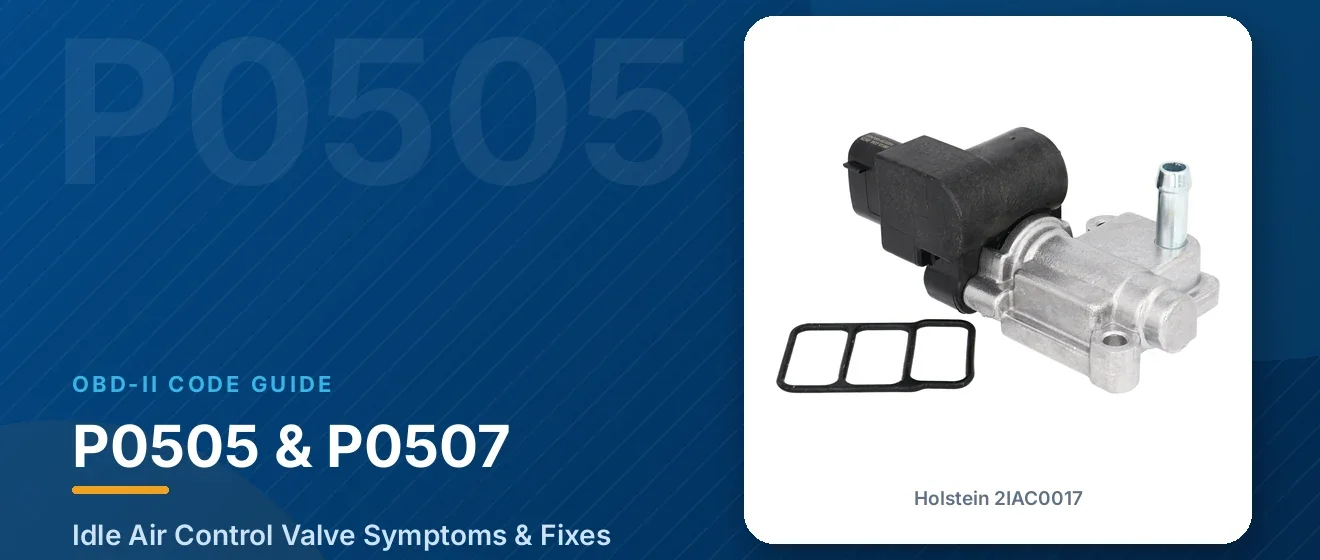
| HOLSTEIN 2IAC0017 Idle Air Control Valve | Holstein | Honda, Acura | $56.40 |
Prices may change; the product page shows the current price. “Listed for” shows the makes on the listing. Check the full fitment list for your year, model and engine before ordering. If your vehicle has electronic throttle control, or the cause turns out to be a vacuum leak or carbon buildup, an IAC valve won’t fix it.
FAQ
Can I clean an IAC valve instead of replacing it?
Often, yes. Carbon buildup is a common cause, and cleaning the valve and its passages can restore normal idle. If the coil or motor has failed, replace it.
Does my car have an IAC valve?
If it has electronic throttle control (no throttle cable from the pedal), it almost certainly doesn’t. Idle is controlled by the throttle body motor instead.
Why is my idle high after I replaced the battery?
The computer may have lost its learned idle settings. Many vehicles need an idle relearn after the battery is disconnected; check the procedure for your vehicle.
Is it safe to drive with P0505?
An engine that stalls when you slow down or stop can leave you without power assist in traffic. If it’s stalling, get it repaired before driving regularly.
Safety note: This diagnosis guidance is general and may not match your vehicle. Confirm the fault with a qualified technician before replacing parts. US Automotives is an independent retailer and is not affiliated with any vehicle manufacturer.