
Quick answer: P0171 means bank 1 of the engine is running lean (too much air for the fuel), and P0172 means it’s running rich. For P0171 the usual culprit is unmetered air from a vacuum leak, a cracked PCV hose or a faulty PCV valve. P0172 more often points to fuel delivery or sensor problems.
What P0171 and P0172 mean
Both are generic OBD-II powertrain codes from the SAE J2012 list:
| Code | Generic definition | Bank 2 equivalent |
|---|---|---|
| P0171 | System Too Lean (Bank 1) | P0174 |
| P0172 | System Too Rich (Bank 1) | P0175 |
The engine computer uses the upstream oxygen (or air/fuel ratio) sensor to keep the mixture on target. It does this through fuel trim: positive trim means it’s adding fuel to correct a lean mixture, and negative trim means it’s taking fuel away to correct a rich one. When trim reaches the limit the computer allows and the mixture still isn’t right, it sets P0171 or P0172. Bank 1 is the side of the engine with cylinder 1; inline four- and six-cylinder engines only have bank 1. Manufacturers word these codes slightly differently (for example, “Fuel Trim System Rich”), so check your scan tool’s description.
Where the PCV system fits. The positive crankcase ventilation (PCV) system draws blow-by vapors from the crankcase into the intake through the PCV valve and hoses. A cracked or collapsed hose, a hardened or missing grommet, or a valve stuck open lets in air the airflow sensor never measured, which leans the mixture. The PCV system can also feed a rich condition. In GM bulletin 18-NA-246, for certain 2013–2019 GM vehicles with the 2.0L turbo (LTG) engine, frequent short trips let fuel collect in the crankcase and set P0172. Depending on model year, the bulletin’s repair is an oil and filter change, plus engine computer reprogramming and a revised PCV valve (on that engine it sits in the camshaft cover).
Symptoms
| Symptom | Most often seen with |
|---|---|
| Check engine light with no noticeable drivability change | Both codes; very common |
| Rough or unsteady idle, stalling at stops | P0171 |
| Hissing noise from the engine bay | P0171 from a vacuum leak |
| Hesitation or surge on acceleration, lack of power | P0171 |
| Pinging under load | P0171 |
| Misfire, higher fuel use | P0172 |
Likely causes, most to least common
These lists reflect how often repair references name each cause. They are not statistics.
P0171 (lean)
- Vacuum leaks after the airflow sensor: cracked vacuum hoses, a split intake boot, leaking intake manifold gaskets.
- PCV problems: a cracked or disconnected PCV hose, a leaking grommet, or a PCV valve stuck open.
- Dirty or faulty mass airflow (MAF) sensor under-reading the air coming in.
- Low fuel pressure or delivery: a weak pump, a clogged filter or restricted injectors.
- Exhaust leak ahead of the upstream oxygen sensor, which lets in outside air and makes the sensor read lean.
- Faulty upstream oxygen or air/fuel sensor. Less often the root cause than people assume.
P0172 (rich)
- Too much fuel: leaking or dirty injectors, or excessive fuel pressure from a faulty regulator.
- Faulty or contaminated MAF sensor over-reading airflow.
- Fuel in the engine oil from mostly short trips, drawn into the intake through the PCV system. An overfilled crankcase can contribute.
- EVAP purge valve stuck open.
- Coolant temperature sensor reading too cold, which makes the computer add fuel.
- Restricted or incorrect air intake, an oxygen sensor fault or, rarely, the engine computer.
How to diagnose P0171 or P0172, step by step
- Read all codes and freeze-frame data. Note rpm, load, coolant temperature and fuel trims when the code set. If both banks have codes (P0171 with P0174, or P0172 with P0175), look for a cause that affects the whole engine, such as the MAF sensor, fuel pressure or a central vacuum leak.
- Check for technical service bulletins, like the GM bulletin above. Some lean and rich codes have known fixes.
- Watch fuel trims in live data. Strongly positive trim at idle that moves toward normal as rpm rises points to a vacuum leak. Lean trim that gets worse under load points more toward fuel delivery or the MAF sensor. Strongly negative trim confirms a genuine rich condition.
- Inspect the PCV system and vacuum lines. Flex each hose, because old rubber can crack on the side you can’t see. Check the PCV valve grommet and the connections at both ends. On engines where the PCV valve is built into the valve cover or intake manifold, the service manual will describe how to test it.
- Smoke-test the intake if you can’t find a leak by eye or ear. It’s the most reliable way to find small leaks.
- Check the MAF sensor. Look for dirt or oil on the element, often from an over-oiled aftermarket air filter. Clean it only with a cleaner made for MAF sensors, and never touch the element.
- Test fuel pressure against the specification in the service manual for your vehicle.
- For P0172, check the oil. An oil level above full or a strong fuel smell on the dipstick suggests fuel dilution. Injector leak-down or balance tests are best left to a shop.
- Check for exhaust leaks ahead of the upstream oxygen sensor.
- Repair, clear and verify. After the fix, clear the codes and confirm fuel trims return close to normal on a test drive.
Parts you’ll need
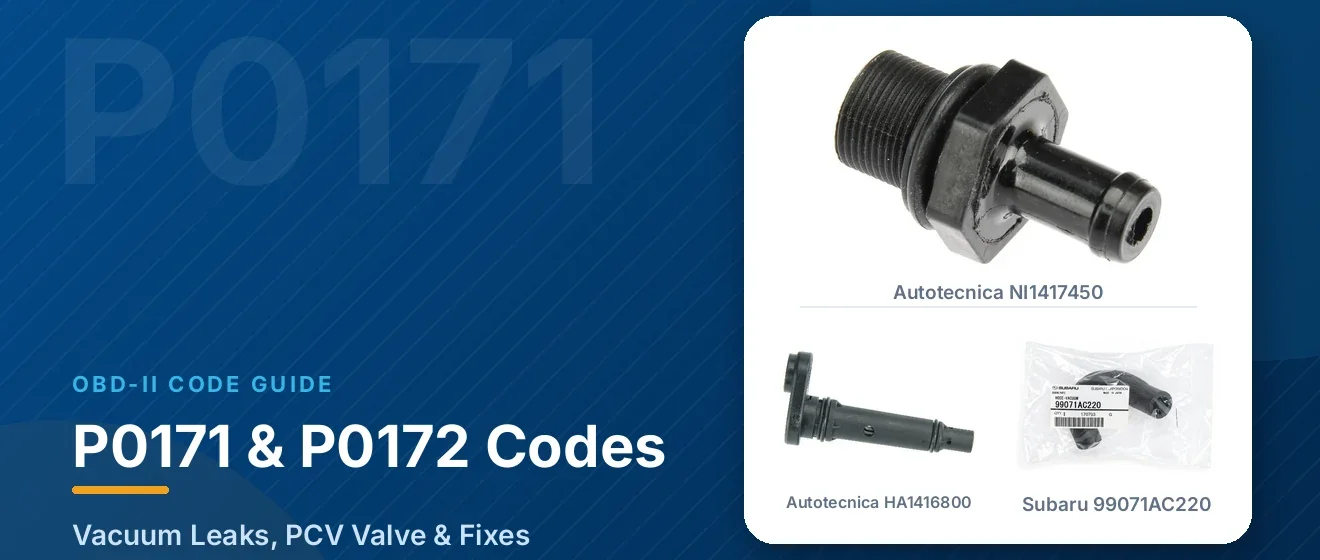
If inspection finds a PCV fault, start with our PCV valves. Examples from the category:
| Part | Brand | Listed for | Price |
|---|---|---|---|
| Toyota 1220422051 PCV Valve | Toyota | Toyota, Pontiac, Chevrolet | $21.48 |
| Autotecnica NI1417450 PCV Valve | Autotecnica | INFINITI, Nissan | $8.01 |
| Autotecnica HA1416800 PCV Valve | Autotecnica | Honda, Acura | $21.76 |
Cracked hoses and hardened grommets are common leak points, so replace them while you’re there. See our PCV valve hoses, which include the Subaru 99071AC220 Breather Hose (listed for Subaru; $14.20), the Toyota 122620D050 PCV Valve Hose (listed for Toyota; $15.54) and the Toyota 12262-28021 Genuine Toyota PCV Valve Hose (listed for Toyota, Scion and Lexus; $23.23). For grommets, see our PCV valve grommets, such as the Beck/Arnley 039-6468 PCV VALVE GROMMET (listed for Acura and Honda; $7.82).
Prices may change; the product page shows the current price. “Listed for” shows the makes on each listing. Check the full fitment list for your year, model and engine before ordering. PCV parts fix PCV-related leaks; they won’t cure a leaking injector, a bad MAF sensor or low fuel pressure.
FAQ
Can a bad PCV valve cause P0171?
Yes. A PCV valve stuck open, or a cracked PCV hose or grommet, lets unmetered air into the intake and is a well-known cause of lean codes.
Can a PCV valve cause P0172?
Less often, but yes in some cases, typically when fuel-diluted oil vapor is drawn in through the PCV system. GM’s 2.0L turbo bulletin is a documented example.
Should I replace the oxygen sensor first?
Usually not. The sensor is normally reporting a real lean or rich condition. Find the leak or fuel problem first.
Why do I have P0171 and P0174 together?
Both banks running lean points to a shared cause, such as a MAF sensor problem, low fuel pressure or a large vacuum leak affecting the whole intake.
Safety note: This diagnosis guidance is general and may not match your vehicle. Confirm the fault with a qualified technician before replacing parts. US Automotives is an independent retailer and is not affiliated with any vehicle manufacturer.